I’m Lydia! I’ve worked with children for the last 20 years and in the last 6 years started with children with SEND. And here lies my passion. I love being creative and finding solutions to the daily struggles that families face all the time when they have children with SEND. My main driver is working with children with speech and language difficulties and creating resources.
SEND Support is expanding and we will be offering Makaton courses before the end of the year.
Makaton has been a passion of mine for years, and then a few years ago I met a young child, who was very sad and struggling because they couldn’t communicate. After being part of their Makaton journey, I saw them come alive and the sadness disappear. It was from that moment that I knew I wanted to support others in their Makaton journey and encourage other children and adults to be able to communicate with this wonderful language programme.
Keep an eye out here for more updates and course dates. We are based in London and will be offering online courses and in person training too!
Play is a fantastic medium for children to explore, learn and experience new things. Sometimes play and learning get separated into two categories and it is thought the two things can’t really meet. But this is simply not true.
Play and learning can intertwine perfectly and children can learn new skills (like pouring in water play) or how things move from one place to another (playing with cars) or even over coming fears through play (if a child is scared of a dog, then playing with soft toy dogs or playing dogs with friends, helps them to understand their fear and supports them to process their fear).
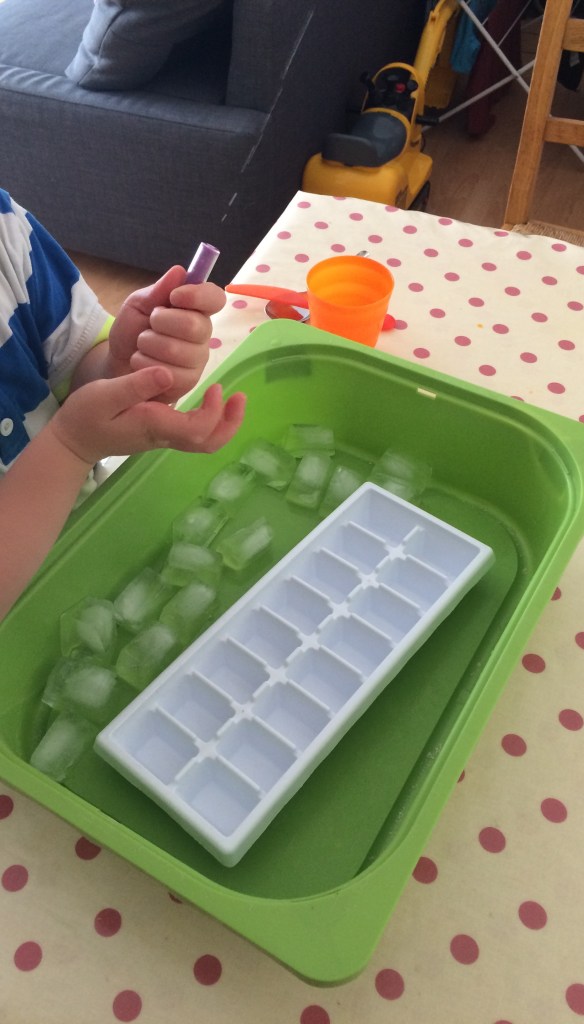
Water Play
So it stands to reason that speech can also be supported through play too. This is the same for children with additional needs and those without, all children can benefit in their speech through play.
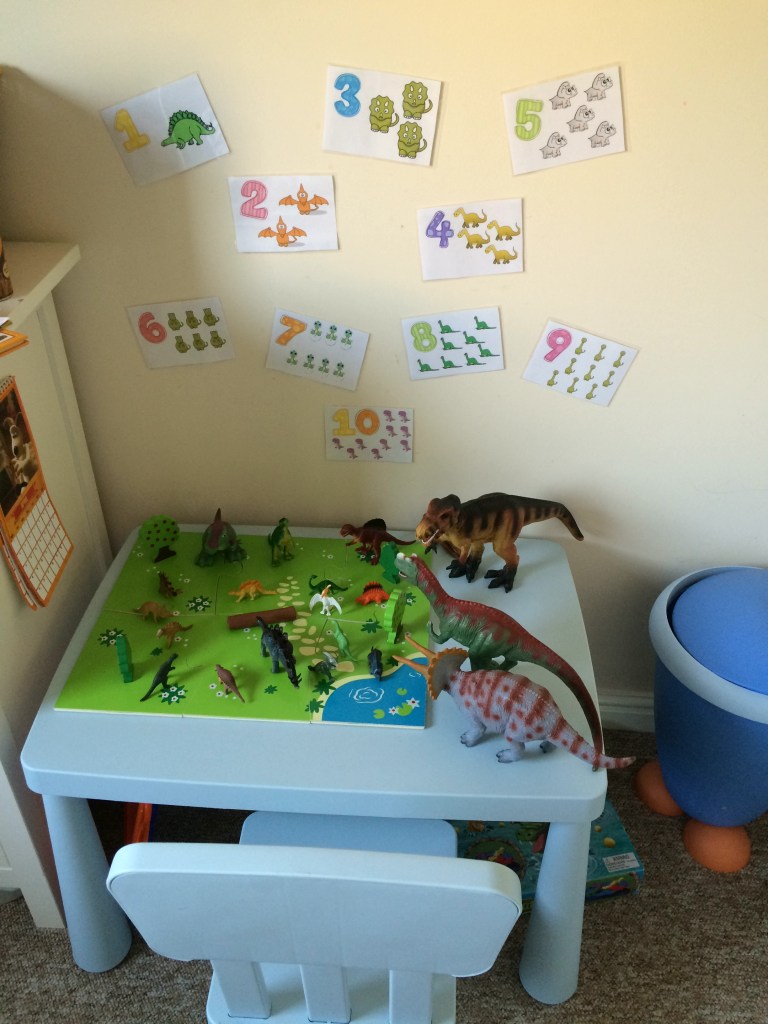
When a child is playing they use this experience to use the language they have learnt in their everyday. For example playing with cars, they may use the sounds they have heard cars make – vroom vroom. Or they may use language used around cars e.g. come on, over there, faster etc. Playing with dinosaurs can help explore sounds such as Roar and stomp. So even children with minimal speech can explore sounds and language through play. And through play, children can feel safe to use the language they have and to try out new words.
You can use play to also help support children learning new words. Play is very visual, so by you showing children the objects they are playing with and using the correct words to name them you are giving them a visual representation of what the word is and what the word means. For example, you are playing together with a farm and there is a cat, if you were to say the word for the first time and they haven’t seen a cat the word wouldn’t mean anything, but as you play you show them the cat, you help them hear the sound a cat makes and they have a real grasp of what a cat is. And as you play you as the adult keep repeating the word, you keep repeating the sound and gradually the child builds the confidence to say cat or to make the sound. This is a very basic example, but it gives you the idea.
If there are words or concepts that you are trying to help your child learn such as ‘on’ or ‘off’, then why not use play. ‘O no the bird has fallen off the tree’. Set up play activities that support the word or concept, and that really encourage language. Even balls going through a tunnel – ‘where has it gone?’
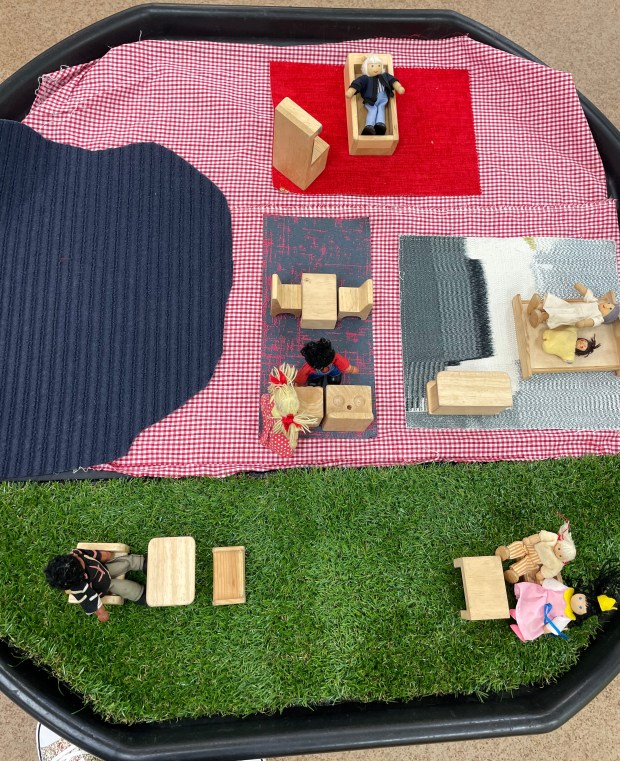
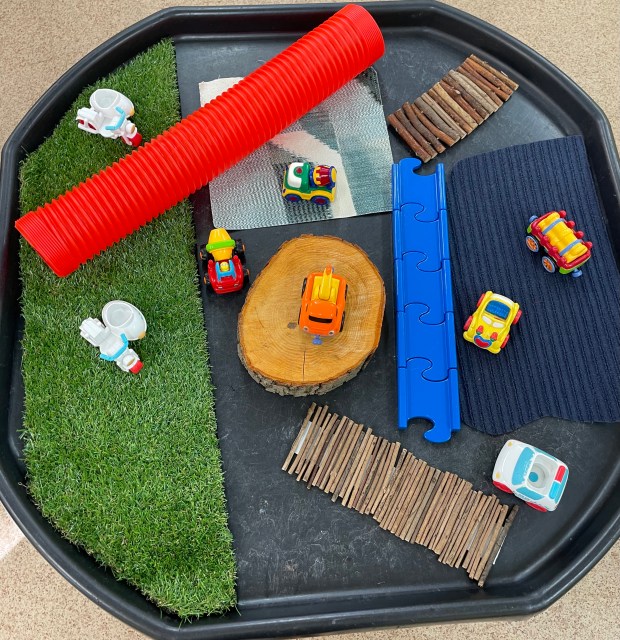
These are some trays I have made for work, but you could also make them just as easily at home with items you have at home.
You could use this type of play to support language about family members, household objects or inside and outside. You as the adult don’t lead the play, but you are involved and you use lots of opportunities to speak about these different topics.
This tray is about cars, but also about the different surfaces they are travelling on – language such as rough, bumpy, smooth can be used. You can think about the car is it going fast or slow. Again so much language can be practiced and introduced with a very simple set up.
For some children learning to talk has to be more intentional and can take a bit longer, but it can also be fun for you and them.
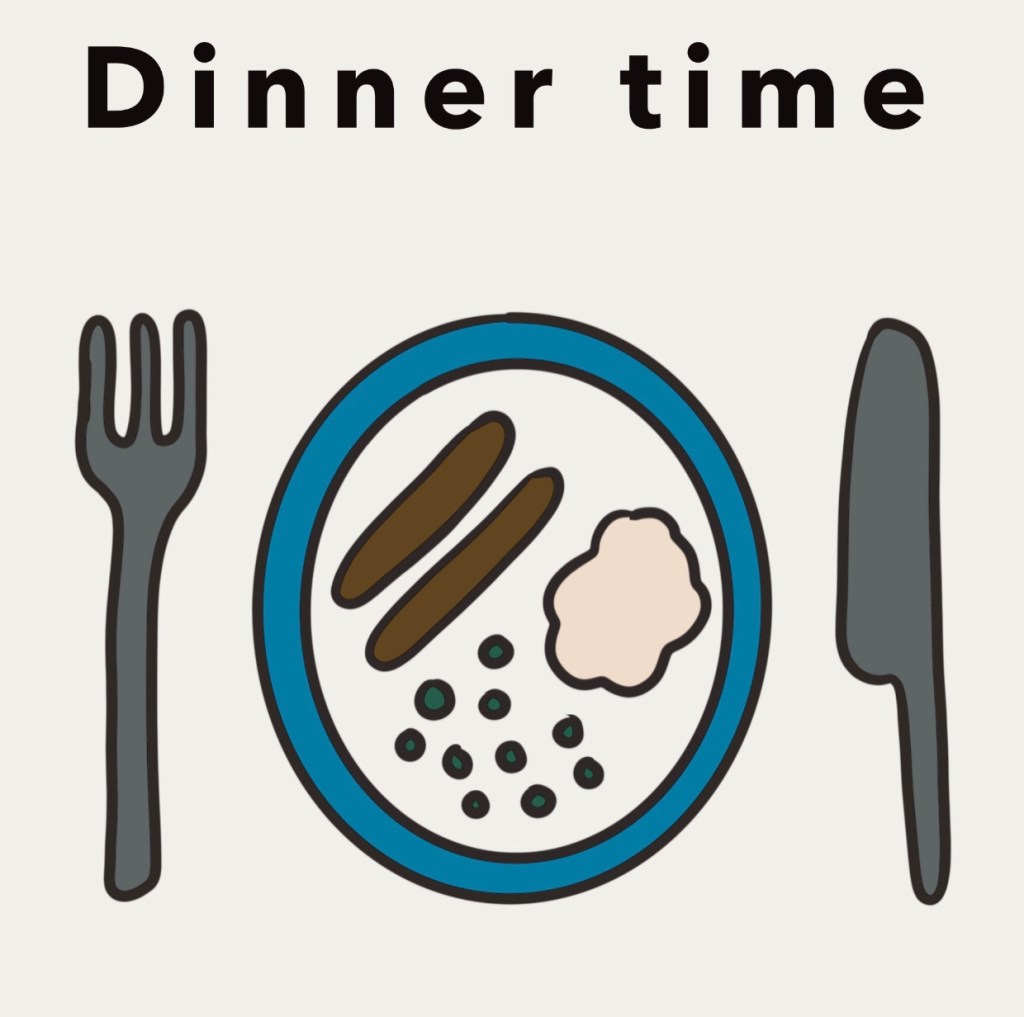
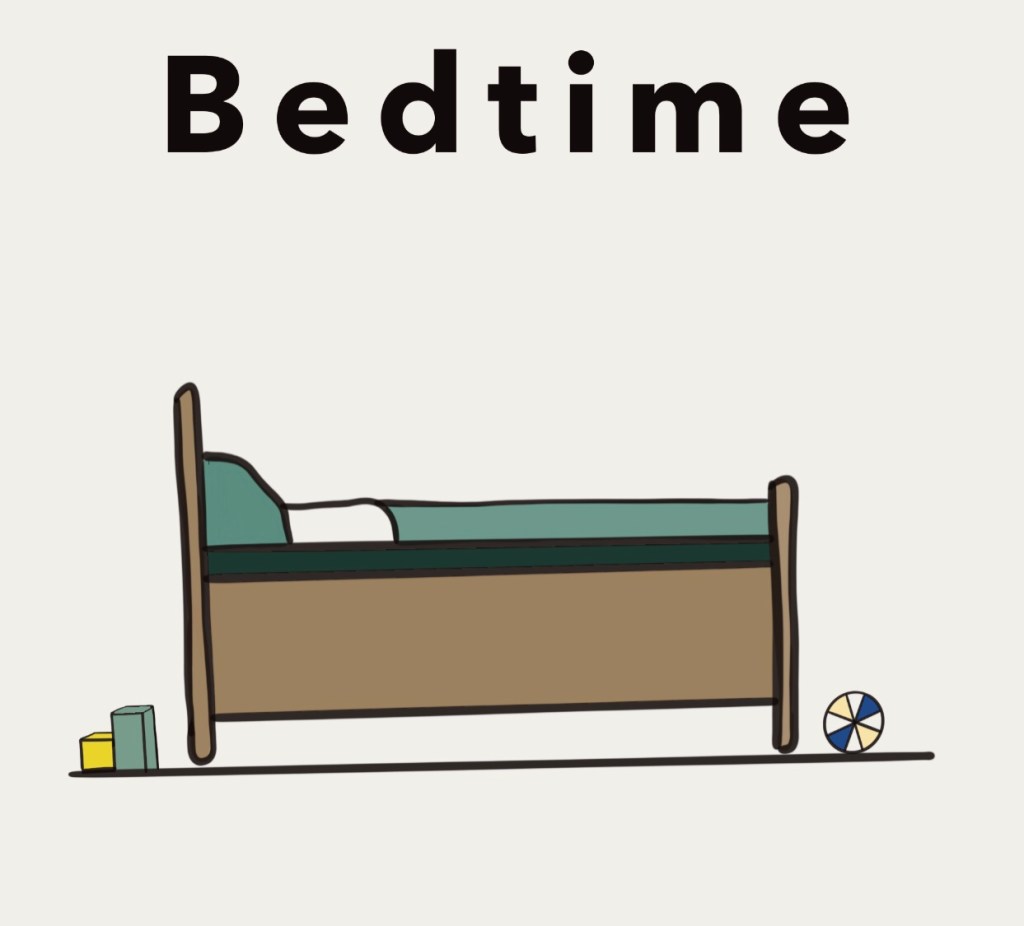
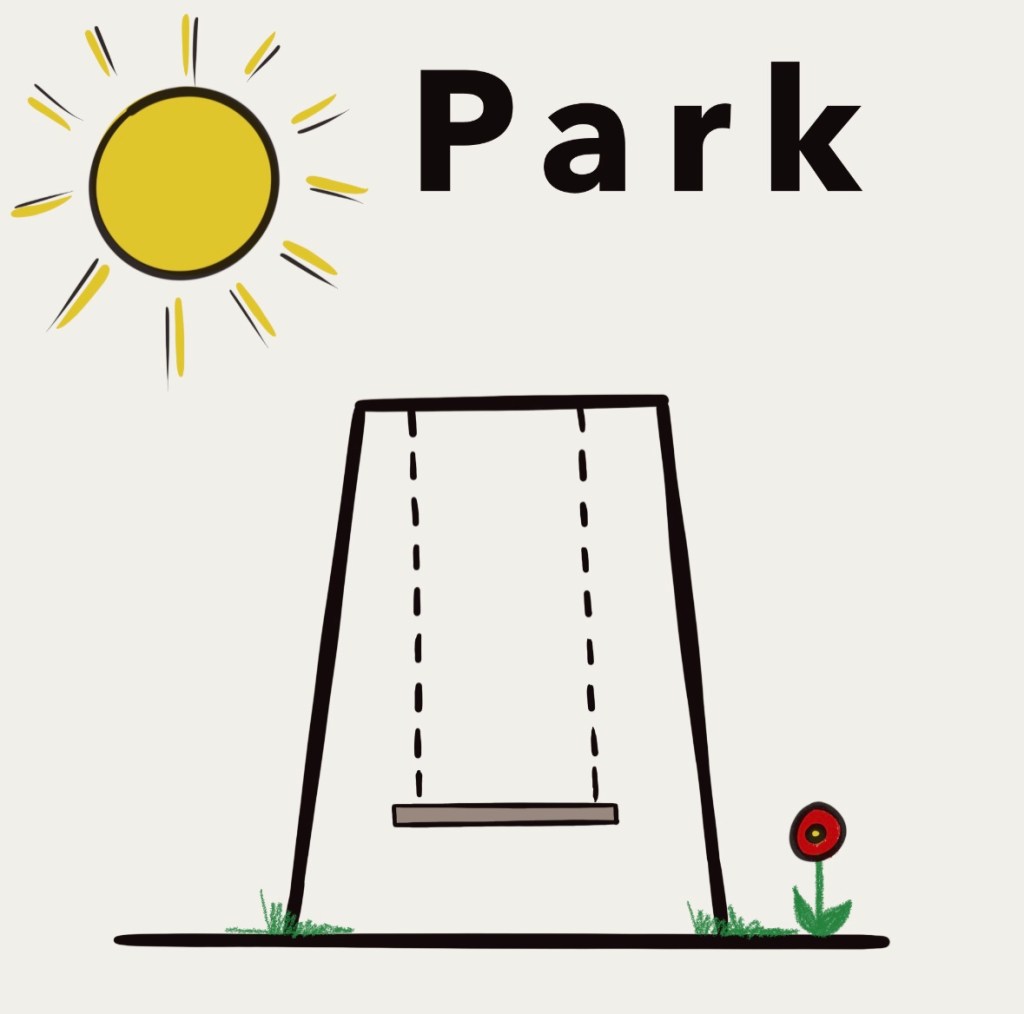
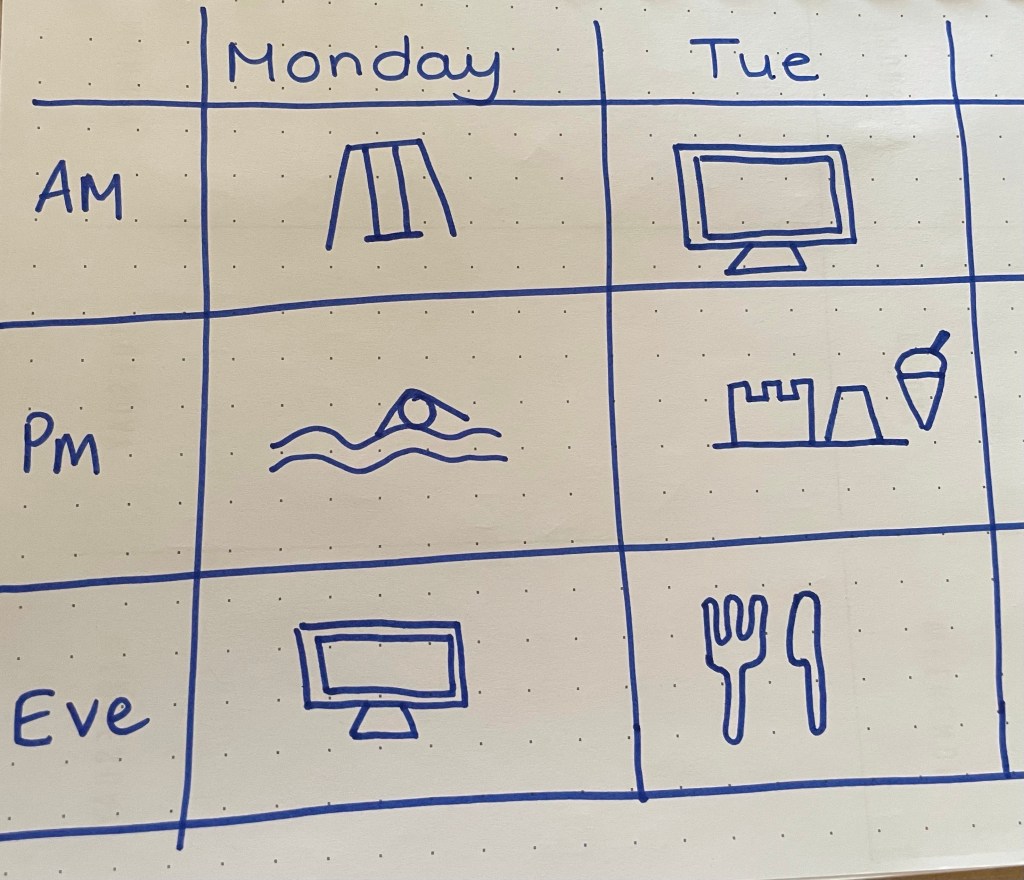
I’ve been spending some time updating my now and next cards. They are all hand drawn and can also be made into a picture time table.
If you would like us to make a now and next board for you or a picture timetable click here for prices. We can make up pictures that suit your routine also.
Every child loves play dough and it is a fantastic sensory experience. They can prod away or make sculptures. When working in school, play dough was great for supporting fine motor skills and if you want your child to stay engaged in with Maths just add play dough – so a small pot was always in bag.
This Play Dough has an added sensory twist with dried lavender and also I have added lavender essence.
Lavender cut from the garden, hang upside down for. a few weeks to dry then add to your Play Dough.
So if you are stuck for something to do or just need a calm down activity, have a go at making Play Dough. You don’t need to add the lavender so don’t let that put you off making it.
The Recipe… This Play Dough is also completely edible (admittedly you wouldn’t want your child consuming this much salt – but I don’t think it would get that far).
The recipe is…
1 Cup of free running salt
2 Cups of plain flour
1 tablespoon of vegetable oil
2 Cups of boiling water (straight from kettle).
Edible glitter, dried lavender or dried herbs – optional
Food Colouring – optional
Cream of tartar – again optional but it helps it last longer.
It’s so easy to make:
Simply mix everything together
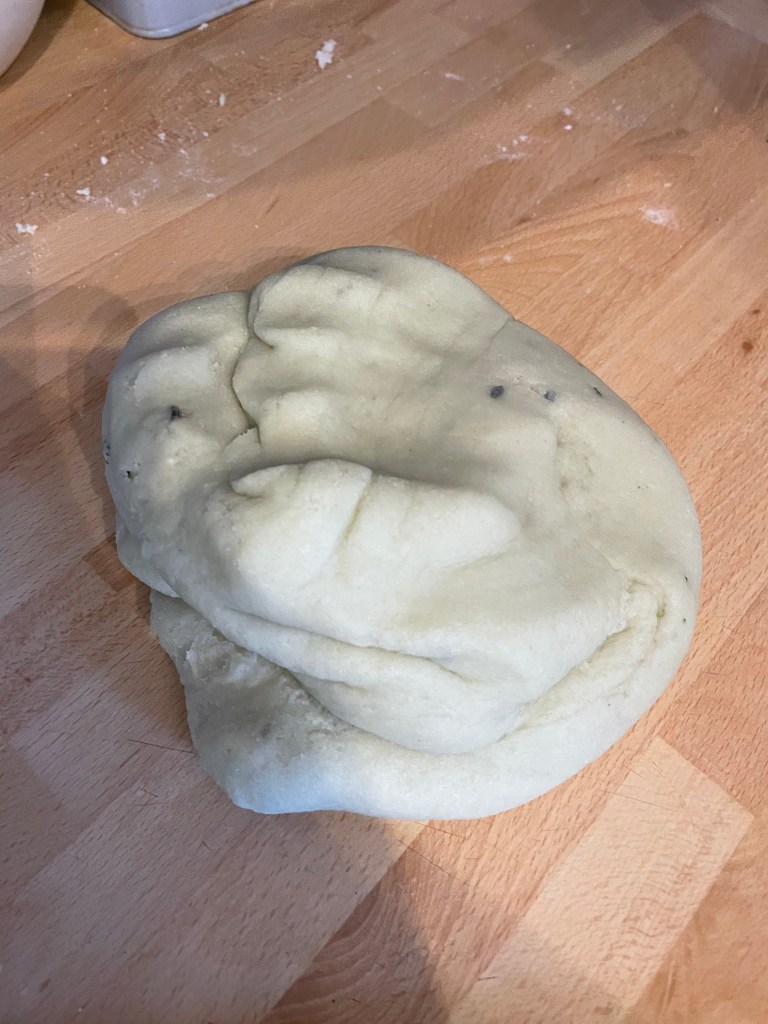
When all ingredients are mixed and it looks doughy pour out onto your floured worktop and knead until a good consistency. (I have added green food colouring, but I am not sure you can tell!)
You also don’t need lots of fancy equipment to play with it either. If you can add a rolling pin, a spoon and some pots and let their imagination take over.
The holidays are I imagine a period of missed emotions. It’s wonderful that you can spend all this time with your children and do all the fun things you can’t do during term time. But at the same time there might be an element of dread or worry that things are going to more difficult than normal (and normal is generally difficult).
If you are feeling all those different feelings then imagine what your little one might be feeling: – change in normal routine – Different structure to the day – More tired because of late nights – Anxiety due to travelling and staying in different places – Being unsettled because they don’t have their normal stuff around them.
I often find that the main frustrations come from my little one not knowing what is happening each day. With school they know what is happening each moment of the day, with some changes, but they know what is happening and how long roughly each thing is going to last. Then the holidays happen and all of a sudden there is anxiety about how each moment will be filled.
So to combat this we make a plan for everyday and write it out so it is accessible and seen by all. Even if your plan is to have a lazy day – write it down. Our days definitely go better when everyone knows the plan.
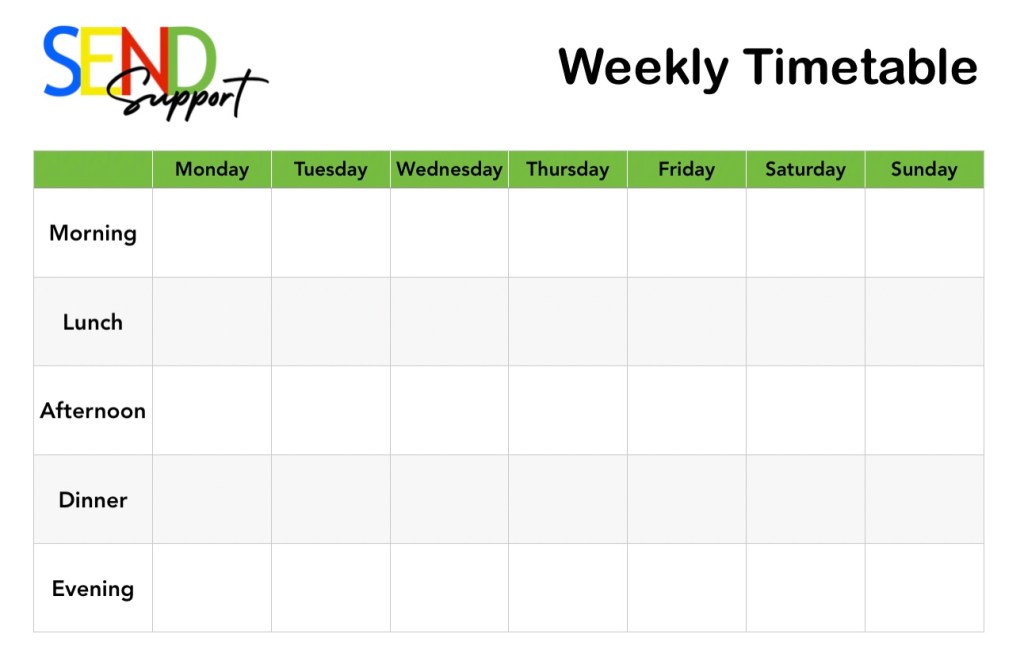
Your timetables can be as simple as write out or draw a picture for what is happening in the morning, afternoon and evening or you can go into more detail.
You can either just put one day up at a time using a white board or you can present the whole week. It just depends on what is best for your child. Also don’t be worried if the plan changes just simply cross it out, explain the change and rewrite the new plan on your chart.
I have made a weekly timetable chart, which you can download above and print out. Print out as many as you need for your holiday or if you have multiple children doing different things and hopefully it will slightly help towards having a smooth holiday.
Using a picture timetable is another strategy you can have in your tool belt that may help those tricky times of day!
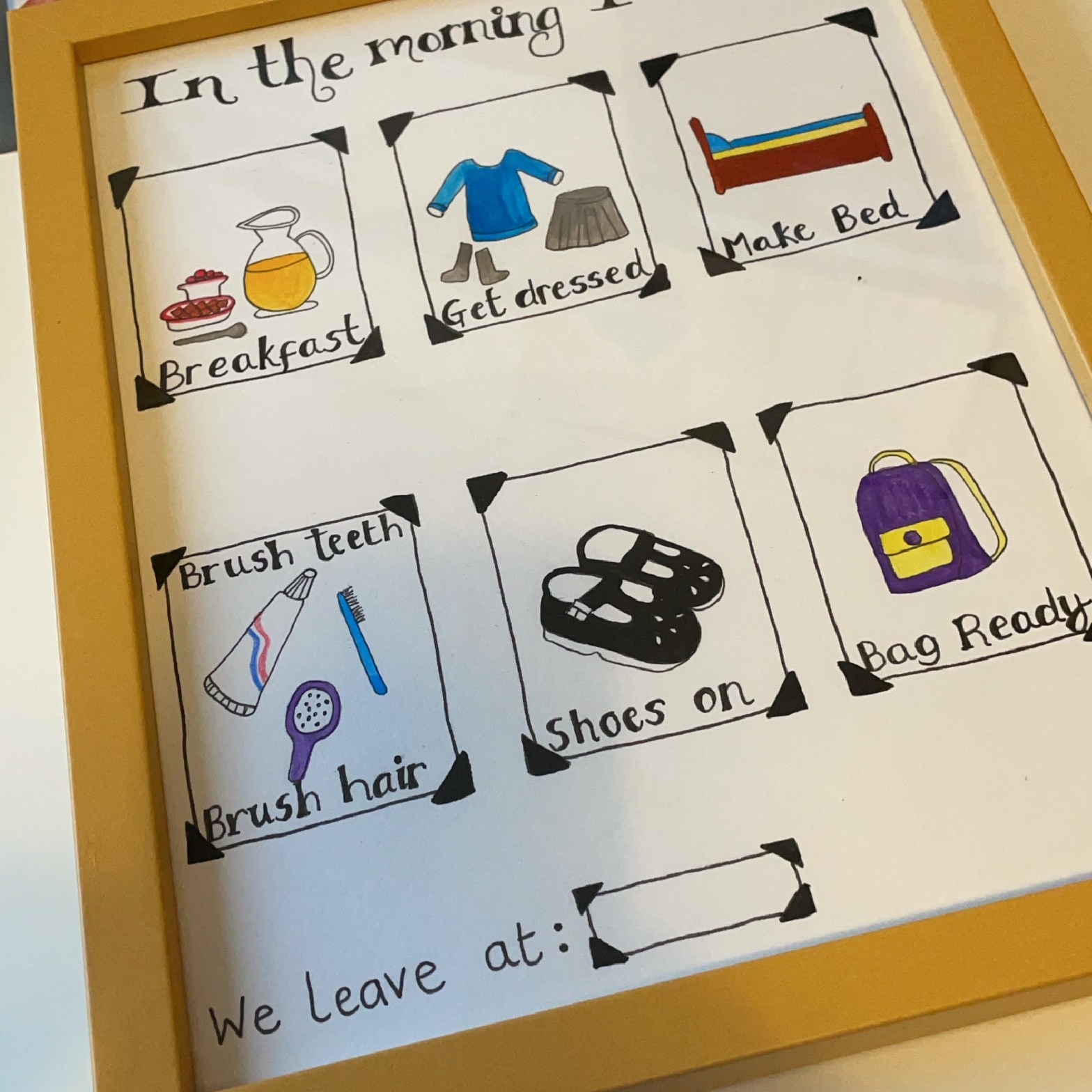
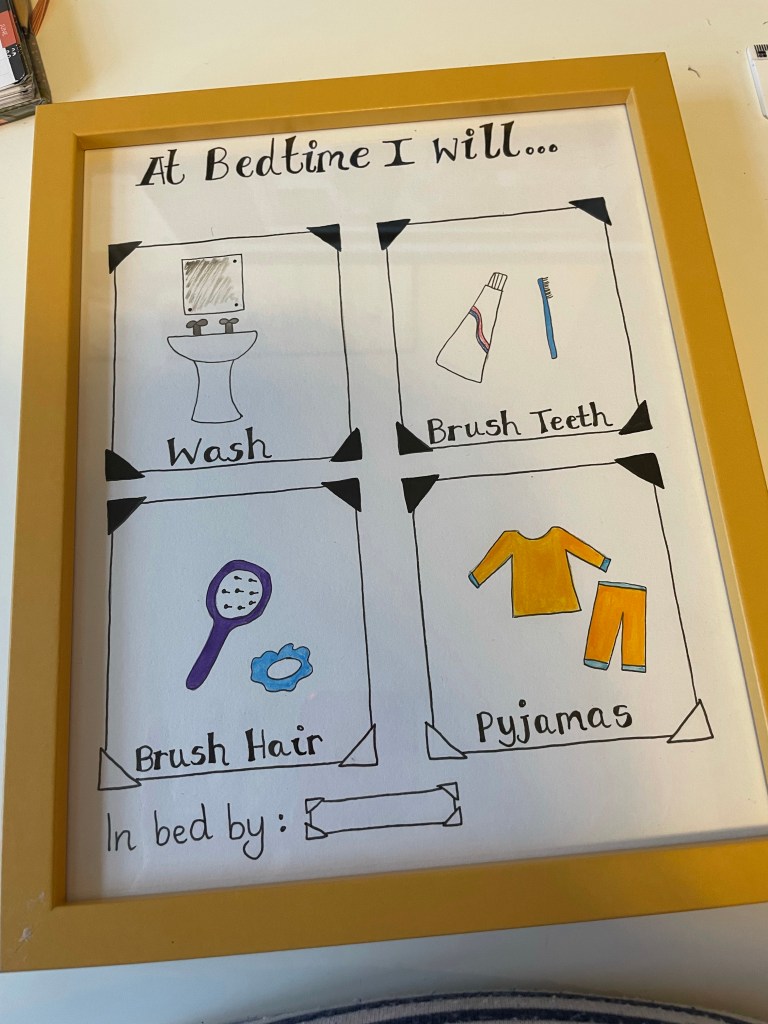
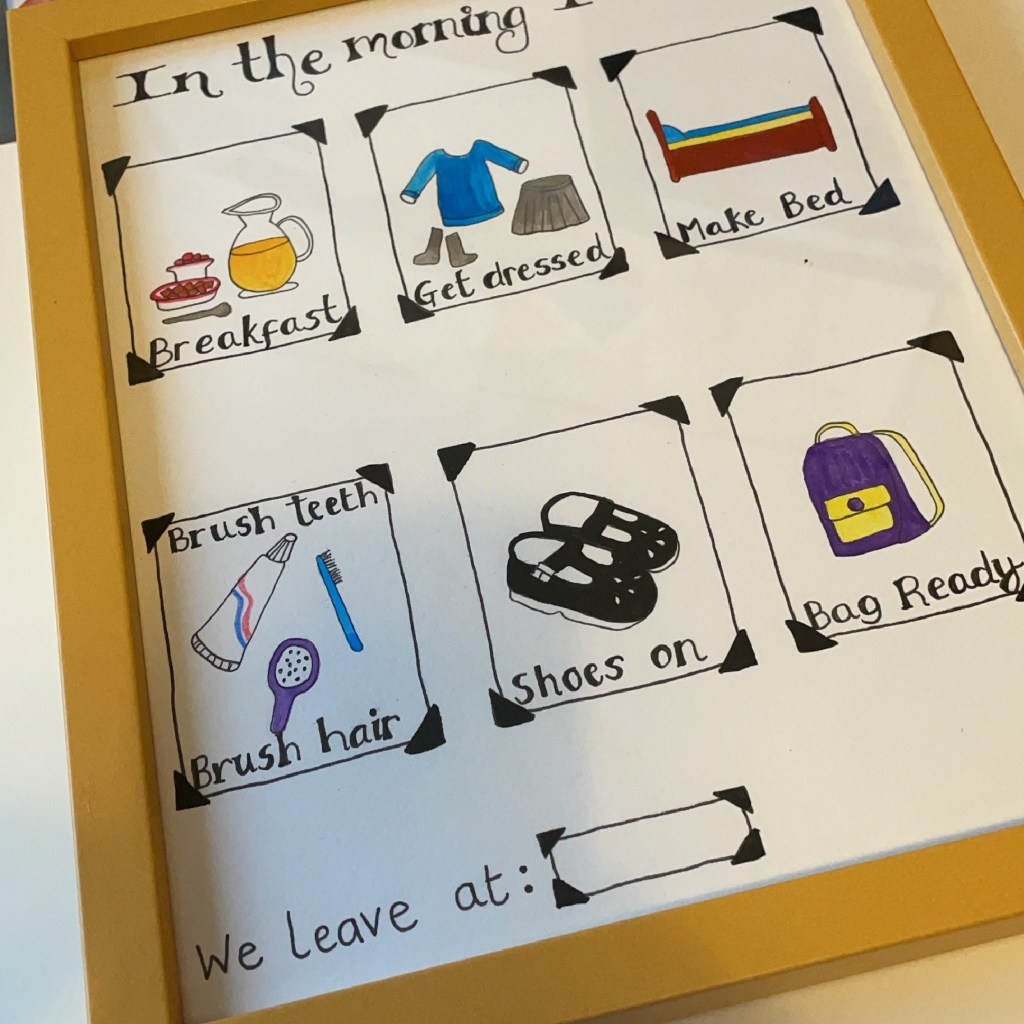
Very similar to a now and next board. But this time all the activities are all there in front of them and you tick them off as the activity is completed. They are really helpful for times like getting ready in the morning or getting ready for bed.
What is great about these frames is they become the authority; it’s not you nagging, its the frame telling them what to do.
So how do you use them? First break down the main activity into smaller tasks. E.g. Getting dressed is the main activity – break that down into small jobs, such as put on trousers, put on socks etc. You can either take photos or draw the items. Then put it in a picture frame. Make sure you put the frame in a prominent position, somewhere it will be seen and somewhere your child can reach it. When you are doing those tasks – go to the frame and see what the first job is. Do the job and then using a white board pen tick it off. Then look what the next job is and so on.
If you don’t feel confident in your drawing skills send me a message with the activities you want and I can make one for you for £10 or £15 for two.
My little one is a bit older, but I can now say – “go and look at the jobs on your frame” and mostly mornings are a million times better. But we have used the frame now for quite a few years.
The other great benefit of putting it in a frame is that you can wipe off the ticks and it’s ready for using again the next day. See if it works for you.
I’ve definitely been in a place (still am sometimes) where my child’s behaviour is so overwhelmingly awful. In those times you feel like you have two options: 1. Let the wave of despair overtake you and give up 2. You decide to give yourself a good talking to and say enough is enough.
So please hear me when I say I know it can be difficult and I know for some of you it is just difficult almost all of the time. For those facing that I applaud you and think you are particularly amazing. But I do believe, even if you child has additional needs or not, that it is possible to work on at least some of the behaviours and put in strategies that can support you and give structure and routine to your child.
There are some key things to remember when thinking about behaviour:
1. The behaviour is always telling you something – Has the behaviour got worse in the last few days? Are they coming down with something?
– Does your child struggle to communicate? Is the challenging behaviour a way of expressing frustration?
– Have things changed at school or at home?
– Are they needing a bit more attention?
To name but a few of the reasons. But maybe if you can take a step back from the situations you may find that there is a reason for the behaviour.
2. You can’t combat all issues at the same time, you and your child will get overwhelmed. For example, my little one when a lot younger would not walk up the stairs to our 2nd floor flat. He could walk up the stairs, he just wouldn’t. He would lay on the stairs or scream or generally send me over the edge especially when you had loads of bags and no lift! At the same time meal times were horrible – getting up or throwing food. To make matters worse bedtimes were also very difficult, and the list could go on! But instead of tackling all the issues at the same time, I had to decide which was the more problematic and then focussed on that one.
If you focus on one issue you can give your attention to that issue, also you can gain confidence as things change and also it can give you hope that success if possible.
3. Turn round the negative into a positive It’s so easy when you are tired and possibly despairing to only look at the negative behaviour. Don’t worry we all do it! If you can use strategies that encourage you to look for the positive behaviour, your child will pick up on this. Strategies such as:
– Every-time they do good listening – put a marble in a jar, can the jar get full by the end of the day.
– Put a Lego brick on a the tower every time they are kind – how tall will the tower get by the end of the day.
– Reward charts for eating their meal well.
By turning round the negative behaviour and looking for the positive both you and your child can start to form new habits, you can start to see that your child can do good listening even if at the moment it is only half the time. Children with ADHD particularly respond to praise and rewards so all of these strategies would be great if you child has ADHD or ADD.
Below is a reward chart you can download. Write in the top box, what you want to achieve and in the bottom box write the prize they will get when they have 8 stickers (don’t go large with your prizes – this won’t be the last reward chart you will do.)
4. Model it I remember once shouting to my child ‘stop shouting at me’. And it made me realise that I shout a lot. I certainly won’t judge anyone who shouts and it’s not a habit I have been able to break 100% of the time. But if I want my little one to stop shouting at me, I need to stop shouting first. If you want your child to be brave about something, do you need to show them what it is to be brave? I mean not all challenging behaviour our children exhibit is stemming from what they see you do, I certainly didn’t go round biting people!! But there are somethings that we can model.
I know this post doesn’t necessarily solve specific issues, maybe that will come at a later date. But hopefully it will help you look differently at the challenging behaviour and give you the confidence to challenge the behaviour!
Let me set the scene. You have been at a play group with your child for the last two hours and you have had a brilliant time. It’s time for the playgroup to finish and so you go over to your child and pick him up and say it’s time to go, then suddenly there is uproar. The tears start and the kicking starts and all you want to do is run! I haven’t yet met a single parent who hasn’t experienced this very scene.
All children find transitions difficult, whether it’s the big transitions such as starting nursery, changing classrooms or moving house or the small transitions such as leaving play group or having to stop playing because you’ve got to go and get your other child. Children with ASD, ADHD, Sensory Processing and other conditions find transitions particularly difficult too. Mainly because transitions require an element of flexibility, or they have to come away from an activity that they are hyper focusing on or for children with sensory processing, changing activity may result in a change of sensory input, which may be something they find difficult.
But for whatever the reason or whether your child doesn’t have a diagnosed condition there are ways that you can help all children cope better with transitions.
Prepare them – Imagine how you would feel if you were really enjoying something and then someone just came and picked you up and took you away from that really fun thing. You might kick up a fuss too. So prepare them that soon it is time to go. Even though they don’t understand time. You can still say things like we are going in 5 minutes, we are going in 3 minutes etc, but the act of saying that you are going a few times will help process the information and it may not be as difficult for them.
Prepare yourself – Get ready to go yourself before you start telling them it’s time to go. That way as soon as you have told them it’s time to go, you actually can go. They don’t have to wait around for you to get ready or more likely run back to the activity you’ve just managed to get them away from and you have to start the whole thing again.
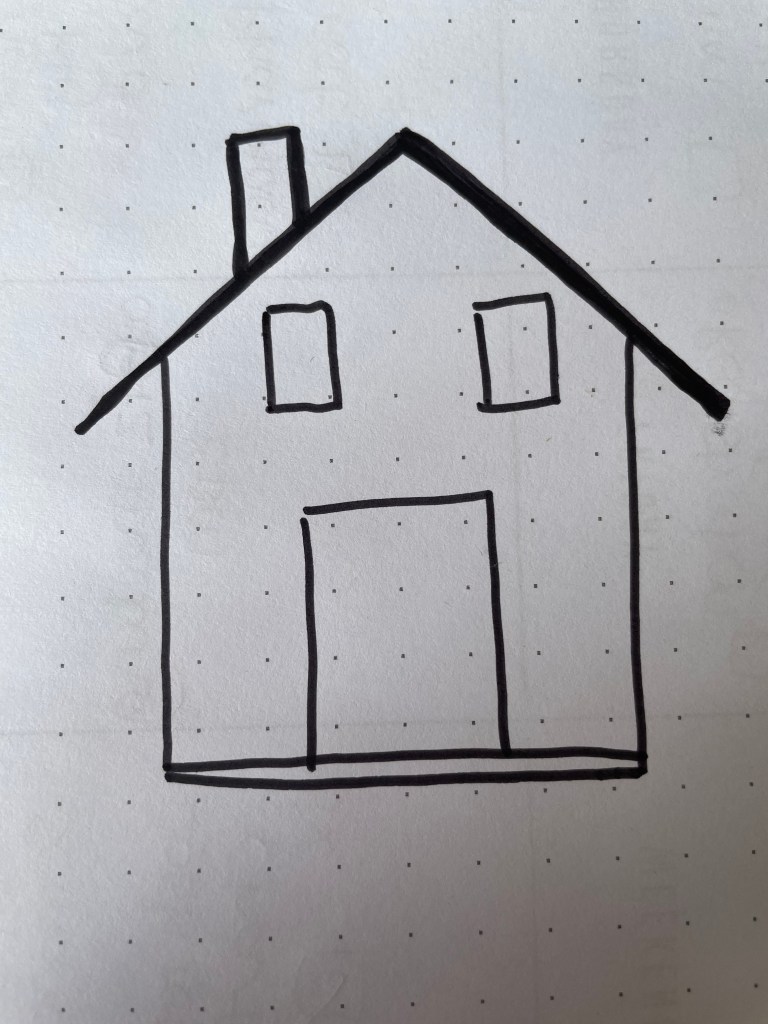
Simple Visual – At work with children who struggle to leave and go home, I have a very simple drawing of a house, that I can show them a few times, whilst saying it’s time to go home. The visual re-enforces the point that it is home time and also can draw their attention away from the activity. You don’t have to be a super artist, but it really supports what you are saying which is ‘we are going home’. Or for example you needed them to go to the toilet, you could draw a picture of a toilet etc.
Visual Timetable – Using a visual timetable again supports your communication of what is happening throughout the day. When we go on holiday and my little one gets confused because of the change in routine. I simply draw a picture for each key event of the day and then we can refer back to it when he needs to know what is happening.
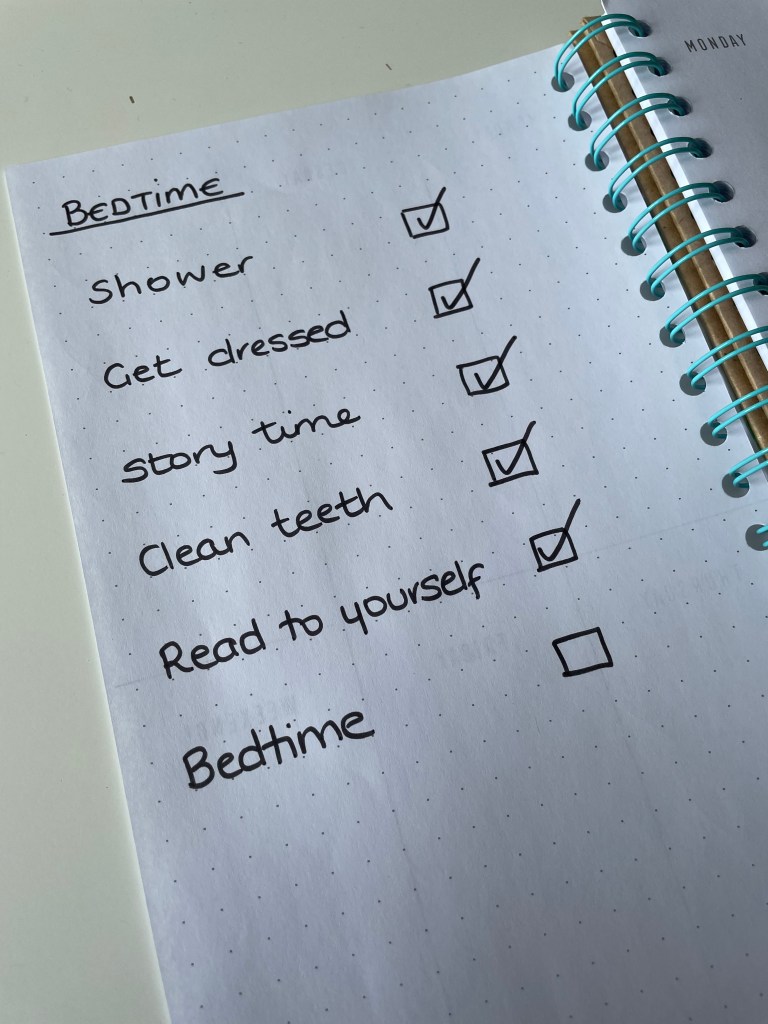
Tick Sheet – This might be better with older ones. But who doesn’t like a to-do list. The key with this is your child is part of actively ticking off the event so they know that it is now finished. It can also show what is happening next.
Now and Next boards – A few weeks ago I wrote a blog post about the benefits of now and next boards. The board has a visual card for each activity and it shows what your child is doing now and what they are doing next so that they are pre-warned about what is going to happen.
Singing – When my little one was really little I would always sing ‘twinkle, twinkle, little star’ when it was time to put on his coat and whilst I was putting on his coat. He knew that when I started singing it, it was time to put his coat on. There are also lots of songs on youtube you could use about tidying up for example that you could sing when it is time to tidy up.
Timers – These days you have timers available on your phone or watch. So you can easily say, “when the timer goes ding ding, it’s time to let so and so have a go with the bike” or you can let them know that when the timer goes off its time for lunch or time to leave. Sand timers are also a really great resource so they can see how long is left.
Social Stories – These are mainly for big transitions such as support with what to do at play time, or moving classes or moving house. But they are a great resource, if you are wanting to really show what will happen and what is expected of them.
Now I am not saying for one minute to use all of these strategies. You need to find the strategy that is right for you and your family. I sometimes use a different strategy depending on the situation. But you will find what works for you!
Hopefully with a few of these in your parent tool belt, you will feel a bit more confident in those times where in the past transitions may have been tricky!
In my job I get the amazing privilege of not only working with children but spending time with the parents too. Naturally parents have a lot of questions and one of the main questions I’ve had recently is “why does my child play like that?”
It was a question I asked a lot when my son was little. I would spend ages setting up nice play activities, then he would come along and just swipe everything off the table. So yes it was a question I would sometimes ask with tears in my eyes. But then I read about Play Schemas and all became a bit clearer and a tiny bit less frustrating. My son was exploring the trajectory play schema.
A play schema is a pattern of play or play behaviour that children go through when they are exploring the world. Through their pattern of play they establish how the world looks and how it works. Research has shown that there are 8 main play schemas. 1. Connecting 2. Orientation 3. Transporting 4. Trajectory 5. Positioning 6. Enveloping 7. Enclosing 8. Rotation I’ll explain each one as we go along, but the joy of understanding what schema your child is currently exploring means you can expand on the play and explore different elements of the schema, but you can know that eventually (possibly) it will pass.
So what do they each mean and what can you do to increase the fun?
Connecting The connecting schema is your child’s way of working out how things come together and come apart. Your child may love putting train tracks together (and taking them apart) or building towers and knocking them down.
Increase the fun: – By dancing together and linking arms.
– Cut strips of masking tape and stick plastic animals to a table or flat work surface – let your child peel off the masking tape to rescue the animals.
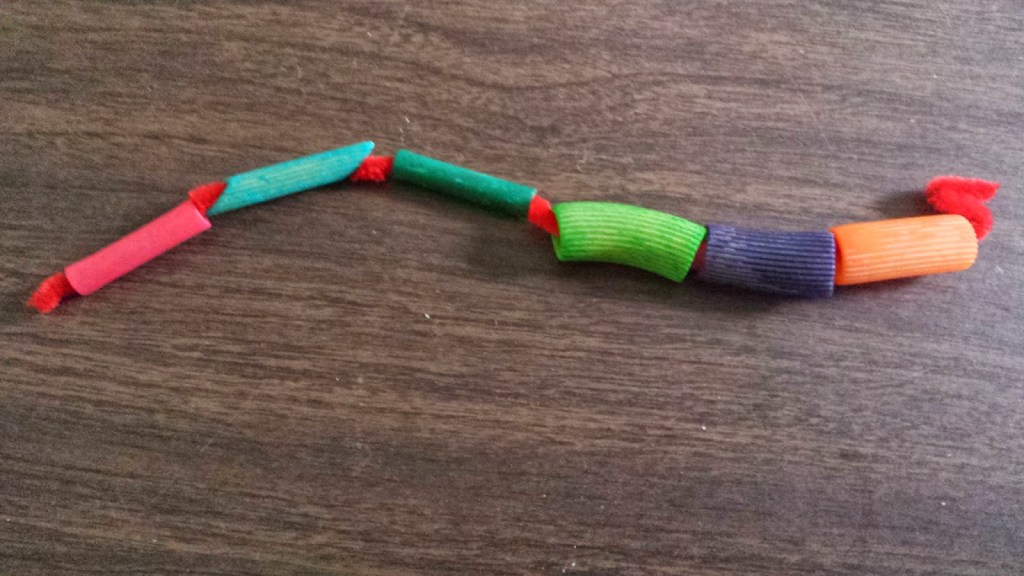
– Thread beads or pasta onto pipe cleaners.
Orientation Your child is trying to experience the world from a different angle or viewpoint. This is useful to support their physical play.
Increase the fun: – Lots of different physical activities such as climbing, running, running down hills and jumping.
– Play from different view points – lay on the floor whilst playing with cars or stand up at a table whilst playing with small world toys.
Transporting Very simply put, moving things from A – B.
Increase the fun – They may like playing with cars, but do different activities with cars, like attach pens on the backs of cars and then move them around big bits of paper and see what patterns they make or stick labels on cars and write on numbers or letters. Then write the same numbers or letters on a big piece of paper and see if they can match them up.
– Have lots of objects around that you can use to transport things. Such as play buggies, wheelbarrows, trollies, bags or baskets.
– Water play with lots of cups – moving water from one cup to another.
– Or a tray of porridge oats with scoops and pots.
Trajectory This schema explores the movement of an object. Your child may drop food from their high chair or scatter their toys. These are mini experiments watching how long something takes to travel or how does it fall, where will it land?
Increase the fun You may not feel like this schema is much fun, as it doesn’t feel very productive. But there are ways to embrace the trajectory schema.
– Play tag
– Roll cars down a ramp
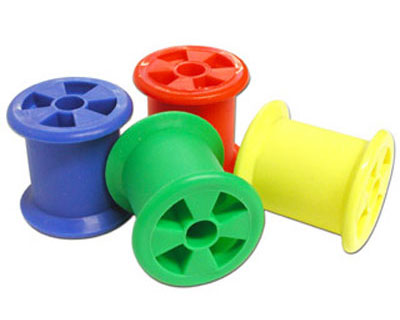
– Push cotton reels off a table into a bucket
– Attach string to two chairs and thread a straw onto the string. Attach different objects to the string and push them along.
Positioning Have you watched your child line up their toys really carefully. This is the first steps to organising and creating patterns.
Increase the fun – Get different objects to line up or sort – go for a walk in the woods and collect acorns or pine cones.
– Threading
– For older ones – have a go at sewing
– Games like Jenga
Enveloping and Enclosing These two schemas are closely linked. It is where the children like to envelope themselves or objects in boxes or materials. Do your keys or credit cards go missing regularly, most probably your child is exploring the enclosing schema.
Increase the fun – Den building
– Make blankets and pieces of fabric available for wrapping themselves up or wrapping toys up.
– Play tunnels for the children to crawl through or make tunnels for toy cars to go through or you can buy rabbit tunnels from pet shops for cars or small world toys to go in.
Rotation Children exploring this schema love watching things that spin or twist. But also they may like themselves to spin.
Increase the fun – Play with hoops
– Find a large space and do lots of spinning
– Get round baking tins and drop them (maybe don’t us your favourite tin) and watch them spin when they land.
– Playing with toys that have wheels
– Attach some string to the underside of a table and attach a bracelet or a hoop of some sort and let your child enjoy spinning the hoop.
Your children may be interested in one or two schemas at the same time or focussed on one particular schema at a time. Just don’t despair, this is your child’s way of learning through play!
Here is a quick look download with the play schemas and activities you can do to increase the fun!
Social stories are a wonderful creation, which were the brainchild of Carol Grey in 1991.
Autism.org.uk describes social stories as “short descriptions of a particular situation, even or activity, which as specific information about what to expect in that situation and why.”
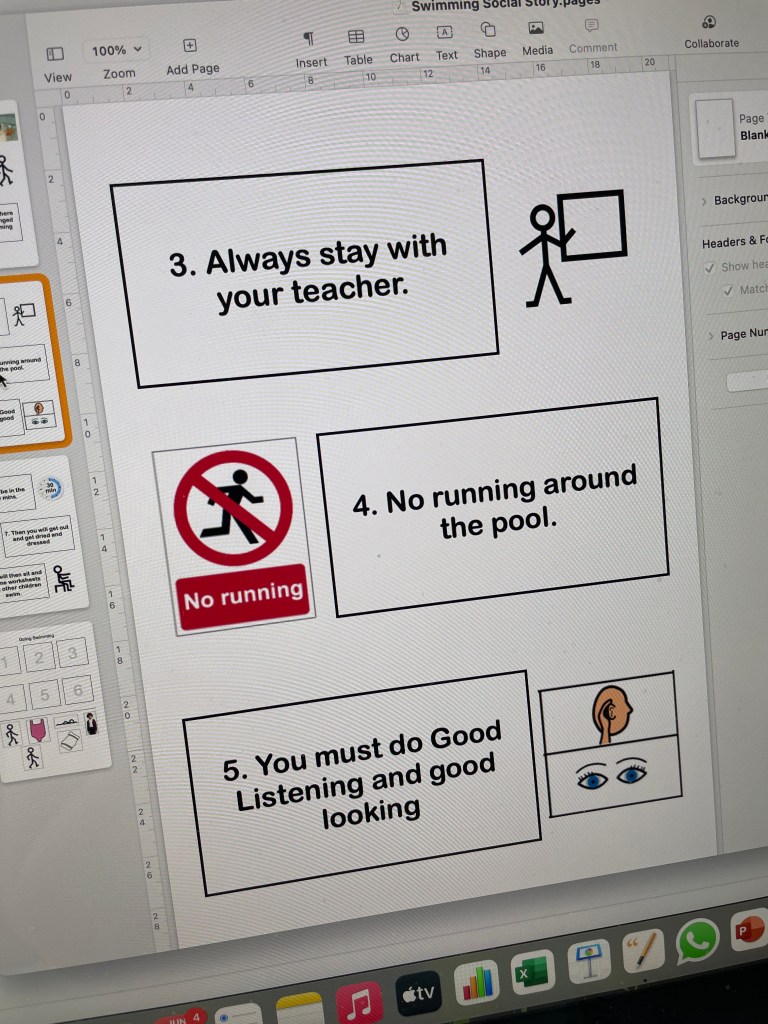
I have used social stories a lot in my work with children with SEND and I’ve also used them a lot at home with my own son. The name story might make it seem like they are long diatribe explaining a situation. But the key to them is that they are short, to the point and Visual.
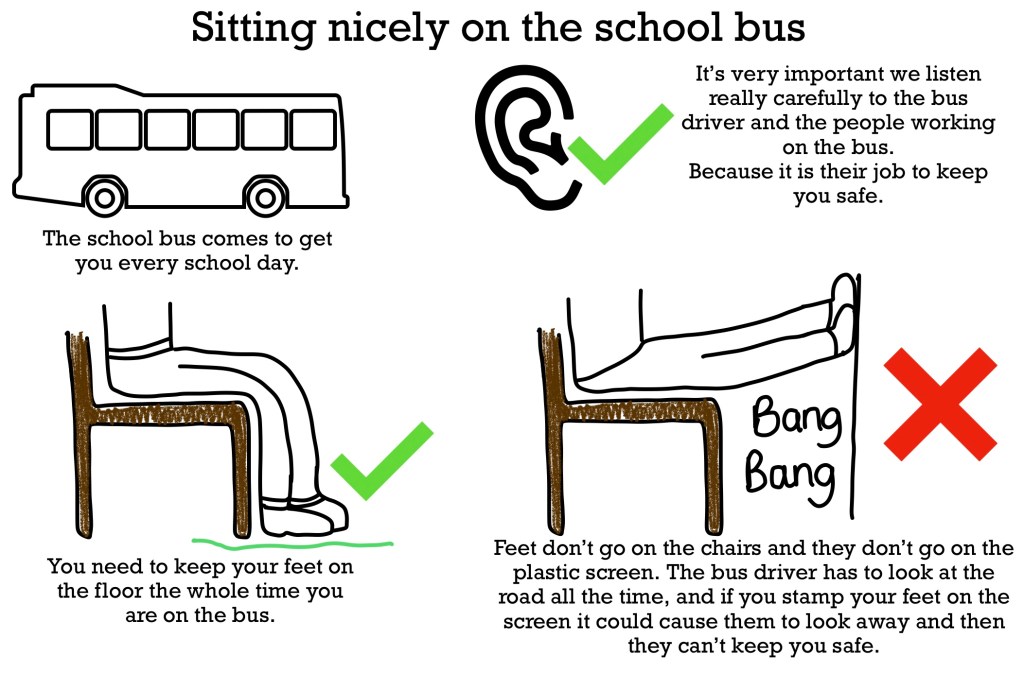
Sitting on the bus social story
They are used mainly with children with ASD, but I have used them with neuro-typical children too. They really come into their own to explain situations that cause the child difficulty or to help explain expectations of a situation coming up.
Situations could be: – Social situations – to help explain what is expected of our behaviour or how we should respond.
– Changes to routine – Something new is happening that doesn’t normally happen or the the routine is changing. Social stories can help.
– How to cope with different emotions – Some children find it very difficult to understand their emotions or know what to do when they feel like they do. Social stories can be used to explain what they can do when they feel angry or upset.
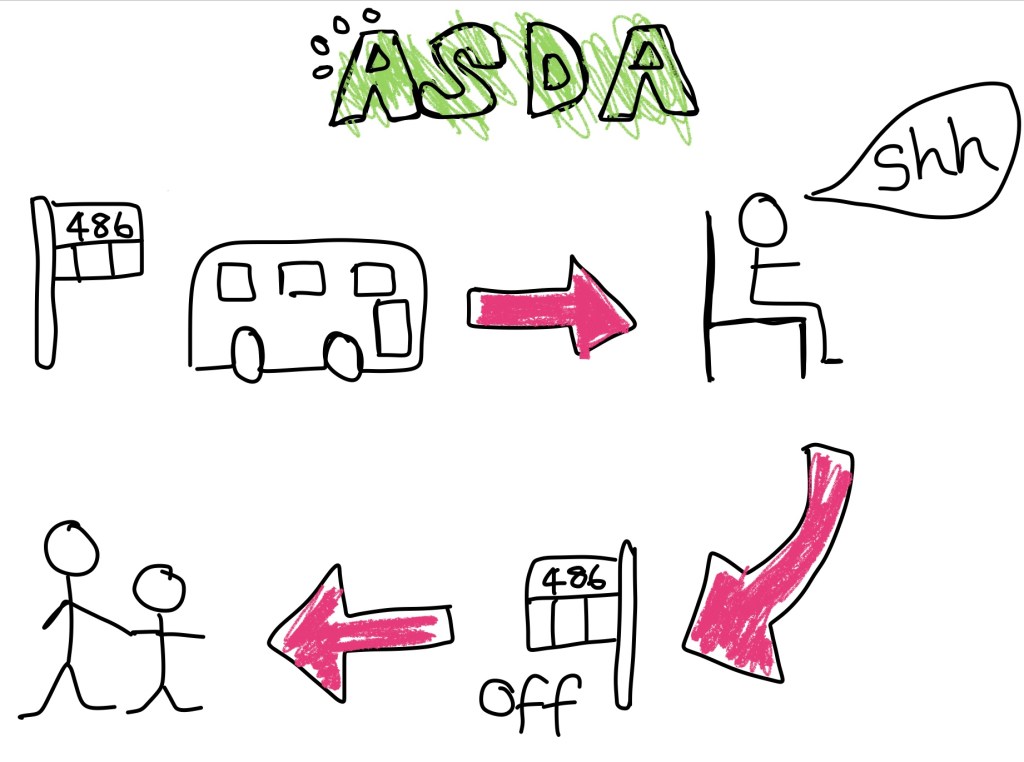
The stories themselves don’t have to be wonderful works of art. You can either use photos or draw the images you want in your story. The story below was written very quickly before a trip to the shops.
Trip to the shops
There arn’t even any words in this social story just pictures. And we talked it through before the trip and throughout the trip too. It explains what will happen and what the expectations of behaviour will be.
Waking up in the morning
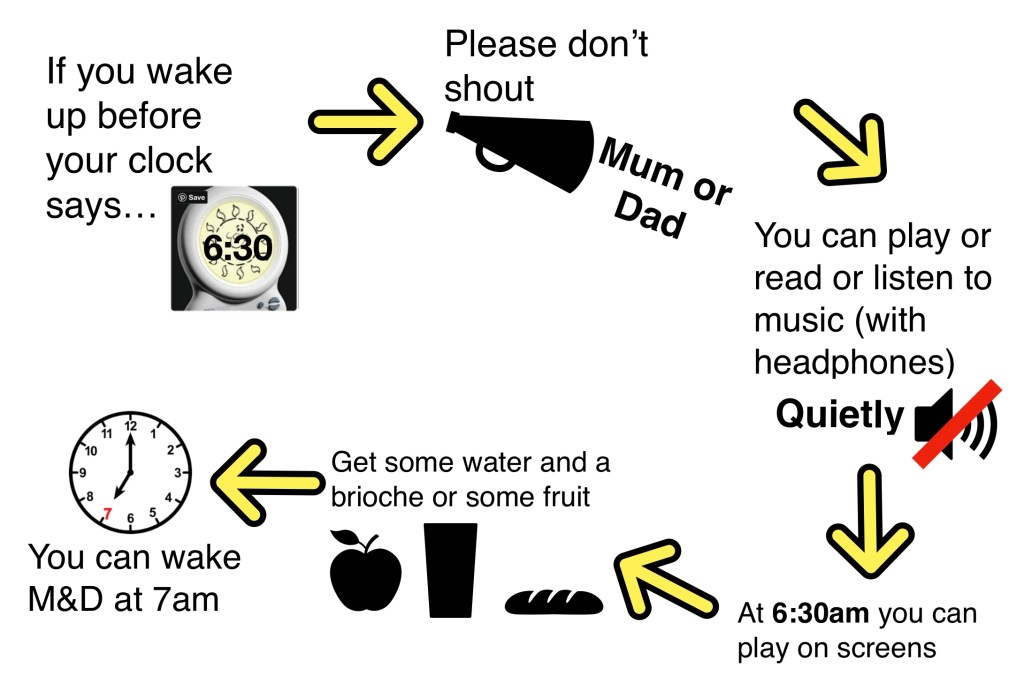
The story above, was something I made as my son kept waking us up before 6.30am (he is a bit older). So I put this up next to his bed and talked it through the night before and he could read it when he woke up in the morning, or if he didn’t follow it we could go through it again with him.
The benefit of them being so visual is that the information seems to stick more. Having it down on paper means you can refer back to it regularly. You can also make smaller versions of them, laminate and keep with at all times if there is a more ongoing issue.
Please get in touch if there is a particular situation that you are struggling with at home or school and I can make a social story to help.










 SEND Support