The Ride Access Pass explained…

We were recently able to apply for a Merlin Ride Access Pass. So I thought I would take the time to explain why we have it and why we are not just skipping the queue because we feel like it (yes that was shouted at me yesterday).

My little one is completely and utterly taken by Rollercoasters. He watches POV’s (point of views) on YouTube, can tell you any fact about them and how much air time you get on each one. So it stands to reason that a preferred day out for him is a day at Alton Towers.

But we have a slight problem, my little one has ADHD. So queuing is incredibly difficult. He can do it because at the end of it is something he is desperate to do. But it comes with issues – like the last two times I’ve queued with him I’ve ended up with injuries and bruises.

So why is this… When a person with ADHD has to queue it’s like an elastic band being twisted and twisted until it’s very tight and at some point that elastic band has to spring back into its original position. This twisting can be a combination of anxiety, excitement and inability to be patient. This then can result in acting impulsively – swinging on the bars of the queue, running away or making incredibly loud noises.

The sensory issues surrounding queuing can also be daunting.

Smells such as food, other peoples washing powder or perfume can be overwhelming.

Loud noises such as others laughing or screeching or the music from the rides itself can cause anxiety or over stimulation.

Standing still for children/adults who are sensory seekers it is agonising as they are all the time trying to meet their sensory needs and therefor standing still doesn’t meet that. So to meet these needs they fidget, move around, jump, touch everything and generally be distracting to everyone around them.

For children and Adults who are sensory avoiders, queues can also be incredibly difficult. Again smells, loud noises and having people near by can cause anxiety and overwhelm. Making the whole process so unenjoyable and therefor they can’t enjoy the experience of coming to the theme park.

If by any chance they do manage to hold it together and queue especially for something like the cinema or the London eye (recent experience), then you find that they can’t actually enjoy the thing they have queued up for because all of their energy has gone into queuing and they can’t hold it together any more. One experience we had, was for a ride and he held it together to queue and do the ride, but it was all too much so came off and was aggressive and shouting. Not fun for us and not fun for him.

For me as the parent, I find queues difficult because I have no idea what will happen or what he will do to meet his needs. And usually it’s me who gets the impact of it. I end up like an elastic band of stress, it gradually getting worse the longer we queue.

Merlin have a great system, so where people may feel we are skipping the queue, we are not I assure you. We queue by walking around the park or playing on the play parks and when it is time for us to ride we make our way to the ride. We can’t go on other rides during that time and we queue for the same amount of time that is stated outside the ride. So we are really not skipping the queue I promise, we are just queueing in a way that means myself and my little one are not hurt in the process of queueing!

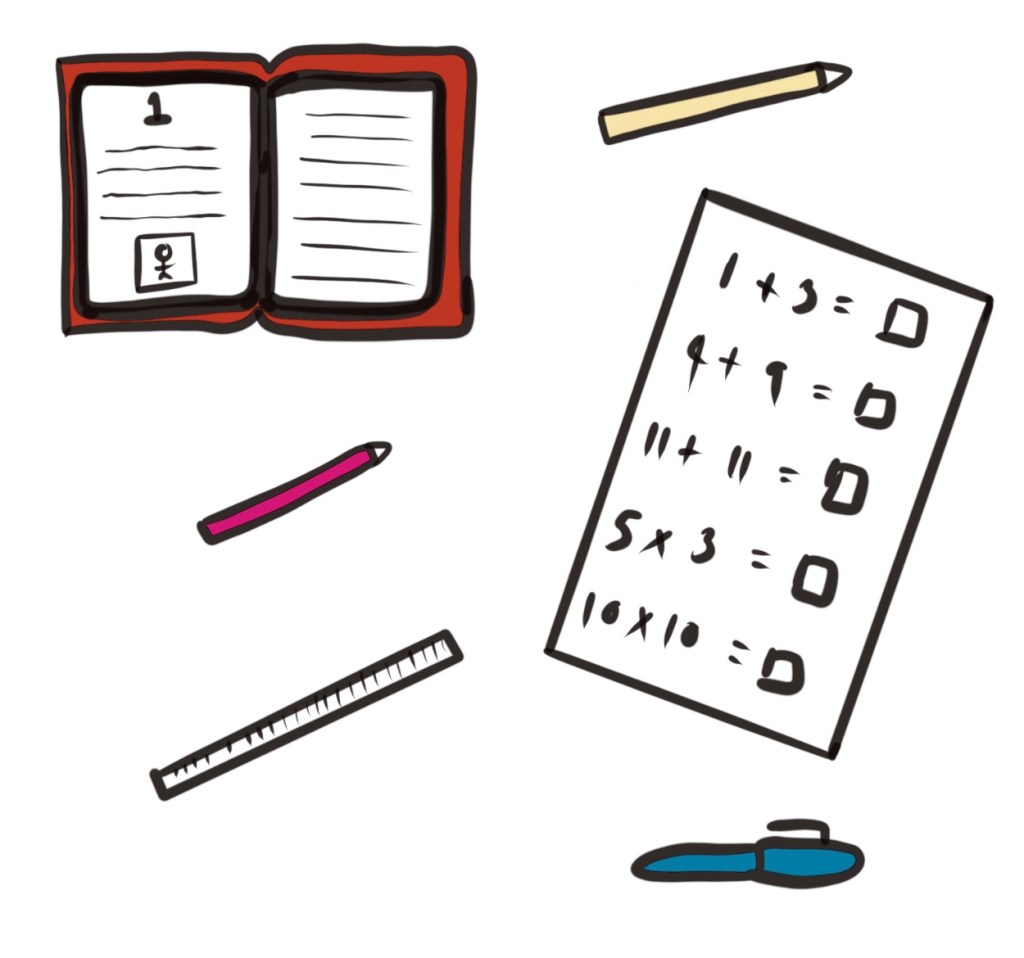
A Class Passport

We’ve only just got a diagnosis for our little one, but I kinda wish I had used this for the last few years. Every year when my little one changes classes, we have to start all over again and I have help my little ones teacher understand him better.

I listened to a webinar about ADHD and they suggested putting everything in writing, a class passport that follows them. Its a quick look about the needs of your child, how their condition effects them and what different things the teacher can do to help.

I don’t think at all that this should replace meeting with your child’s teacher. I think it’s great to build a rapport with them, get to know them and become your child’s cheerleaders. Also some schools may already do this, but I think coming from the parents perspective is also important.

I have put a downloadable version for you to print off and write on. There are definitely other versions out there but I couldn’t find one that was completely right. I hope it works for you.

Caring for the carer

Our little one has recently been diagnosed with ADHD. Which is amazing because it’s been a bit of a fight. But with it has come some unexpected outcomes and feelings. (I’ll go into some of these in more detail in other posts).

But the main thing to become blatantly obvious is I need to care for myself more so I can be a better carer.

For a long time, without the diagnosis you keep holding on because you keep thinking that all of a sudden he’ll change or calm down. So you just keep holding on till that moment comes. But as soon as you get that diagnosis you realise this isn’t just going to dramatically change. This is now long term. And of course that is completely ok. But on the plus side with a diagnosis comes an element of certainty – this is how we now support him.

But this involves a lot from me, emotionally and physically.

1. I have to remain calm at all times. (I do not achieve this) because the moment I become emotional it descends into chaos.

2. I have to be two steps ahead at all times. Children with ADHD have so much internal chaos that they need structure, boundaries and order externally. They can also incredibly impulsive, so you have no idea what they’ll do.

3. Problems which need solving become apparent continuously. You see a problem, you work on solving it, then another one pops up.

4. Children with the hyperactive type of ADHD are so so so so active. I am not active but have to be to keep up. A few miles walk before bed.

5. Sleep is tricky – getting off to sleep and him staying asleep are tricky. I don’t have a full nights sleep very often.

These are some of the tricky bits of life with ADHD, that impact me. But to do all of this. I have to look after myself so I can be the best mum I can be.

So how can I look after myself? I am aware that some of these ways are very personal to me some of them would not feel like self care to you. But keep in mind it may not feel like self care but it might help!

1. Me time – I basically work full time. I help run a childrens centre, I run my own business and I’m studying so there isn’t much me time. I have started to try and put in at least 30 mins me time once or twice a week. Sometimes it’s not achieved but I am trying. I’m doing some training in central London next week so I will be staying an extra half hour for a cuppa in a cafe by myself. I’ve tried doing life without this and it doesn’t work. I get fried and I burn out. I’m no good to myself, my job or my family. So me time it is!! I also treat myself to the odd present here and there!!

2. Systems – This is the one you might hate. But I have a lot of systems in place to help me. I am spinning a lot of plates in life. So I have to put in systems to make sure those plates don’t drop and break. I also have systems that help me feel at peace about life.

3. Partner Time – This is super hard to do. We don’t get evenings and the little one doesn’t just sit in bed and read a book. So we have had to find ways to see each other. We get chance to catch up, mainly chat about who needs the car when but also see each other. My husband and I are a team in this parenting thing and I need my team mate. One way we’ve found is we sit in the garden for 20 mins a week during my sons screen time. (Need some ideas about what to do in the winter though!)

4. Get a support network – We’ve struggled to ask for help. Mainly because deep down I’ve worried about what people will think of his behaviour. But now I am sure I need help! This is what it is and people will have to take us how they find us! We have my parents who help us with the little one and then I have people who I can just talk to, I need to widen the groups a little. But this is all new.

These are just some ideas. What are ways you look after yourself?

Mothers Day verses Birthday

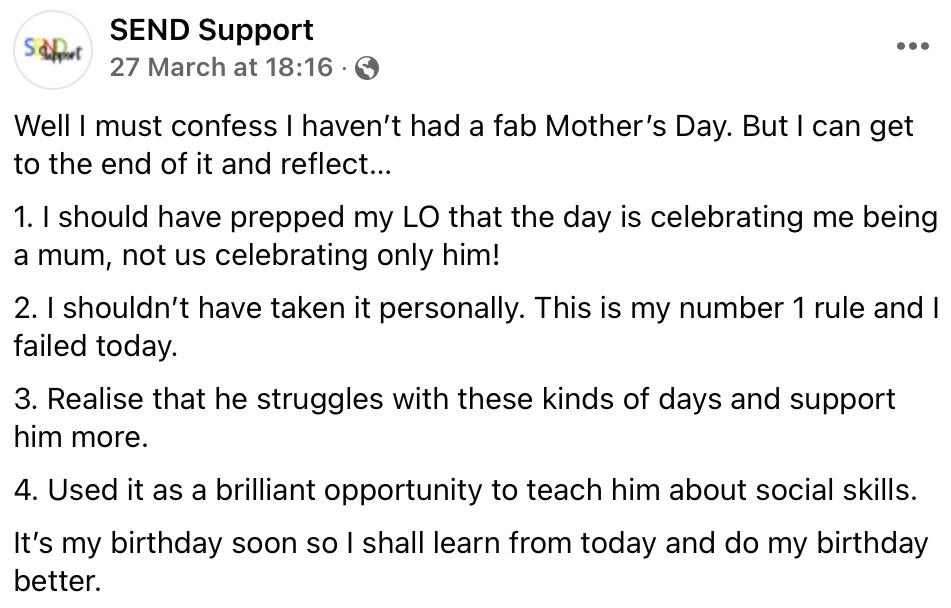
After Mothers Day I posted on FB that it hadn’t been the best day.

It hadn’t been great because my little one hadn’t been prepped at all about a different day and not only was it different, it was about me and not him!

So I challenged myself to have a better birthday and I can say it really was a great day. But to get to that point I had to put in some work. But it really was worth it!

1. Prepping for the day
This started the day after Mother’s Day. I was determined for it to be different. And it just started with conversations. Conversations about my birthday coming up and how birthdays are important days for some people and on those days we should treat them well and treat the nicely.

My husband also took him out on a special trip to buy me some presents. My husband used the opportunity to say that Mummy probably wouldn’t want a rocket for her birthday, can we think of some things Mummy might want!

We talked about it quite a lot, and expressed regularly how he needs to behave.

Because my birthday was during the holidays, we made a holiday picture time table and my birthday was part of that.

2. Taking it personally
This is such a hard one. It goes against everything in you. If any adult or Neuro-typical child behaved in the way my little one did, you definitely would take it personally and you probably wouldn’t speak to them for a while, because you thought they were quite mean, and unthinking.

But as our ADHD nurse put it, you have to reframe it. It’s not him being mean and horrid (even though it is), but he doesn’t understand, he doesn’t know how to do this right, because socially speaking those skills are not honed yet. In some ways the whole day would have been far better if I hadn’t taken it personally. If I’d have realised all of this in the morning and not at my bedtime! If I’d taken it in my stride, then we would have had a better day. For my birthday I was half expecting it to go very wrong, so in some ways it was a complete shock and surprise when it didn’t. I altered my behaviour and tried to help him alter his.

Now I’m not saying his behaviour on Mother’s Day was acceptable. And at some points in the day there were some consequences for his behaviour. But like with all behaviour, we have to ask why? When I reframed the situation, I wasn’t as insulted and put out. Try it next time you’re in a similar situation. I hope it helps.

3. He struggles with these types of days.
We recently met with an ADHD nurse and she said something that hit me like a ton of bricks!!

“Children with ADHD don’t like CHANGE!!”

Now yes I should know this, but it’s never been said in such a clear way. Now Mother’s Day is definitely a change. It’s not part of the norm and it’s very different. This is the same for children with ASD and other neurological conditions.

So you can either give into this and say well we won’t celebrate it let’s just keep everything the same and then you as the mum miss out (again!) or you can allow it to happen and either face the consequences or prep. I personally as the mum don’t want to miss out. I work so hard at being a Mum, I want to celebrate this fact!!

4. See it as a brilliant opportunity to teach social skills.
This is not going to be the only time in his life where he will have to put someone else first. As a child his friends will have birthdays, his family will have celebrations and when he’s older and gets married and has children, that’s a whole lot of putting others first. So this has got to be taught.

We’ve always had to break social skills down into small basic chunks to support our little one. And this should have been no different.

* Putting others first
* Respect others and their feelings
* Understanding how celebrating someone else might make them feel loved and special.
* Why we have special days
* These types of days are a regular thing

Now of course you don’t teach all this in one go. But you drip feed little nuggets. The very act of prepping shows that this is important. It takes time, it might take a few years of it not being great. But have hope!!

Top tips about Speech and Language

A friend of mine, Faye is a speech and language therapist. We trained together to become Makaton Tutors and are starting to collaborate on training sessions. So I asked her to answer some of the most frequent questions I get asked about speech and Language. Keep reading for top tips and speech and language explained.

1. Can you tell me a bit about yourself? And why did you become a speech and language therapist?

Hello, my name is Faye, and I am a Specialist Speech and Language Therapist. I work with children and young adults with complex needs. I decided to become a Speech and Language Therapist after volunteering with a Speech and Language Therapist during Sixth Form. I really enjoyed the therapy sessions; I would visit every week with a young adult with Cerebral Palsy who used a device to communicate. We would go on trips to the local library and art shops as well as working on functional skills such as making a cup of tea. From this my passion grew for Speech and Language Therapy and found that Makaton was something that would be highly beneficial for the clients I support. This then lead to be becoming a Makaton Tutor and here I am today!

2. What are some easy ways to support speech at home?

First of all, it is helpful to clarify that Speech and Language Therapists work and support clients with a a range of communication skills (Not just speech!)

Communication difficulties include:
– Attention and Listening
– Understanding Difficulties
– Expressive Language (talking) difficulties
– Social communication needs
– Word finding difficulties
– Play skills
– Speech and sound difficulties
– Dysfluency (Stammering)
And lots more!

The advice would recommend varies dependent on the child’s age and of course each child is different! For young children I would highly recommend Tiny Happy People for activities and ideas.

3. When would be a time to seek help for speech and when should you just give it some time?

Again, this varies dependent on the child’s needs. As a first port of call I would recommend contacting your GP and Health visitor. They will be able to guide you regarding your local Speech and Language Therapy service and provision.

It may be beneficial to get an up-to-date hearing test for your child to ensure that their hearing is within the expected range. I’d recommend looking at the ICAN Talking Point Progress Checker for more specific advice if you have concerns https://ican.org.uk/i-cans-talking-point/progress-checker-home/

4. If English is a 2nd (3rd or 4th) language being used at home, what are the best ways to support learning English at the same time as the native language?

Continue to speak each language as you naturally would at home. Being multi-lingual is a huge benefit and has been shown to help improve academic success. It is beneficial to use visuals including the real item, photographs, pictures, drawings and signing when talking about vocabulary and talk about the word in English and other languages you use at home. This helps the child to link the object/item to the word in English and other languages.

5. Are books and singing songs great ways of supporting language?

Yes! Books are a fantastic way to support language development, children love to read and re-read (!) stories with parents/carers. As we re-read stories, they become more familiar. Stories for young children usually have lots of pictures which really helps to build their understanding of the vocabulary and story. Books help to also develop a child’s sequencing skills, the idea of a beginning, middle and an end, which is an important skill as they get older in being able to sequence their own thoughts and stories.

Nursery rhymes and songs are also highly beneficial, they are fun, which is the best way to learn! They are familiar and we all sing the same tune (or try to!) for Wheels on the Bus or Twinkle Twinkle and this will be the same when your child is at nursery/school and with you at home. Songs can also have actions, or the song can be Makaton signed which further helps to develop understanding of the word or action.

6. What are some other ways to support language even if my child doesn’t have additional needs? Is signing helpful for children without speech conditions?

Signing is helpful for all people; children, adults and everyone in between. For children, we know that adding movement when learning helps build connections in the brain to help learn and remember the word.

Using Makaton Symbols is also highly beneficial as this provides visual information to an instruction or activity. The Makaton Charity is aiming for more people to learn Makaton within schools and in the community so those that use Makaton as their communication tool are able to interact with everyone and aren’t just limited to communicating with those who know Makaton. Makaton is for everyone, all children can benefit from learning and using Makaton to develop their speech and language skills even if they do not have any additional needs.

ADHD and Covid

I know I am a bit late to the party, but I didn’t confidently feel I could write about this until really having to deal with it.

Covid has rocked all of our worlds in one way or another. For some it’s been the push they need to make big decisions and for some its completely put a stop to things.

For us covid has had a number of impacts some not great and some great! When it all first happened, we realised that our support networks for our active bean (my son) were things like swimming, gymnastics, the indoor skate park, the trampoline park. These were the things we used to survive on a daily basis. And these were all taken away as soon as Covid arrived. This was a disaster for us. Plus we lived in a second floor flat, so getting outside and getting exercise or at least the amount of exercise needed was tricky. So for a while it was bad! What was good is we were able to ask for help from the school and it finally gave us the push we needed to move to a house with a garden and a trampoline. Which has made a significant difference.

We’ve been able to get back some normality as the time has gone on, we’ve gone back to the trampoline parks and the skate parks and weekly gymnastics.

But then my active bean got covid recently and had to self isolate for 10 days. All my fears were realised, I have dreaded being in for that amount of time. We’ve never done it. But although it wasn’t as bad as I thought, it did get me thinking. Especially as when track and trace call and ask if you need any support and the women got a diatribe about how we need to do more about support adults and children with ADHD whilst self isolating (I’m not sure she knew what to make of it).

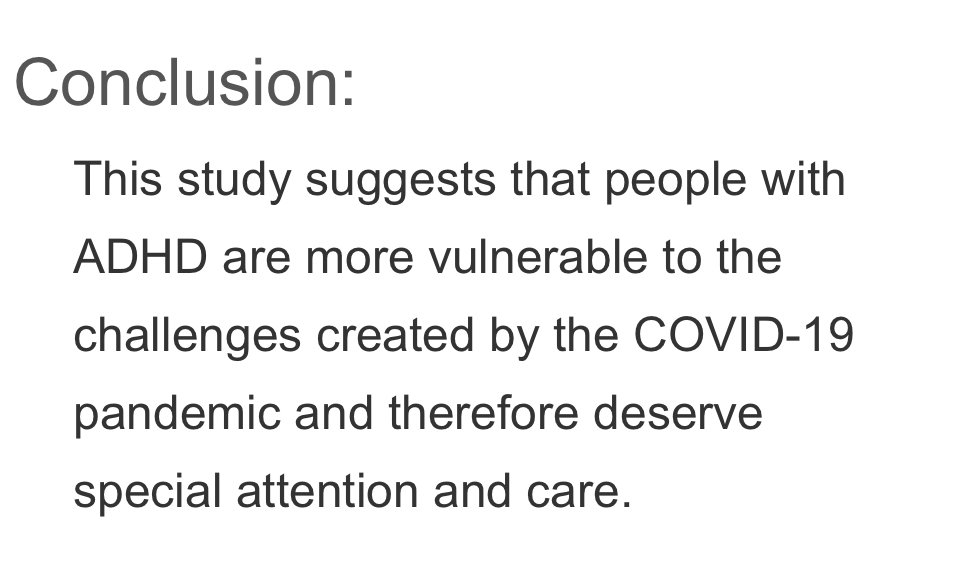
I then read a research article about covid and ADHD (I’m so sorry but I can’t find it again) but the conclusion was this…

So what are some of the challenges? and what can be done?

1. No exercise – during lockdown at least we could get out for at least an hour a day (no way near enough, but it was something). But when self isolating there was no way we could leave the house. Annoyingly it also rained a lot so the garden was off limits too.
Answer One day we did a lot of running on the spot, another day we joined in a session of Apple fitness. Another day he just slid down the stairs a lot!

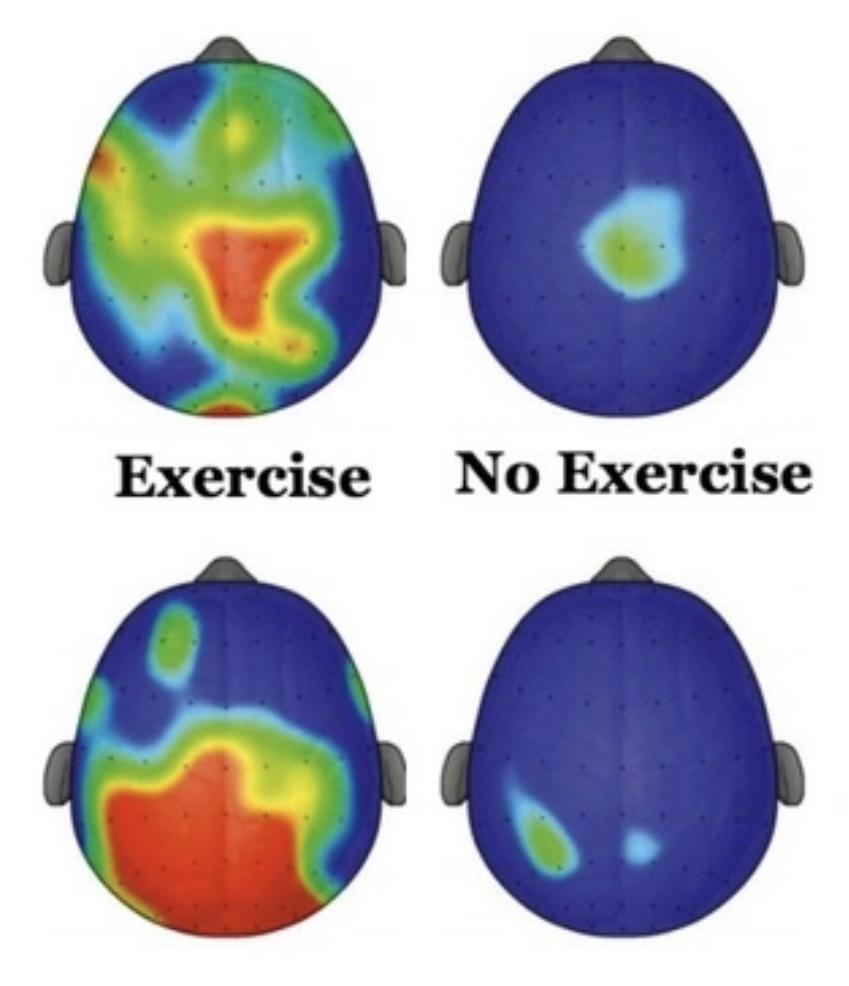
Another research article I read supports the absolute need for physical activity. They scanned peoples brains who have ADHD and after physical activity they were able to have the greatest amount of executive control.

The red represents the greatest amount of executive control and blue represents the lowest.

We find this so much in our every day life, after school we have to go out on some massive run or climb or something to allow him to unwind and then the evening is better. So if in self isolation make time for physical activity. Carve out the time, if you have a child with ADHD find a fun way to make room for at least 10 mins of physical activity, life will feel a bit better.

2. No structure – There was no structure for us, it was the Christmas holiday, so we didn’t have to do home learning. We also obviously couldn’t see family or do all the things we’d planned so that was difficult. It was our decision that we wouldn’t have restrictions on screen time, but we did try to plan in at least one activity a day. I must confess that this was tricky, but we did manage it. We used the joy of amazon to buy in new activities such as Polymer clay or games, and we enjoyed a lot of cake and watched films together.

3. Cabin Fever – This did get to us, especially my little one. By 5pm most days he would be having a melt down. So we began to plan things in for around this time. Fire pits (If it wasn’t raining) or a nice dinner. But mostly we were just with him in the melt down.

The reality is self isolating with someone with ADHD is tricky, self isolating with someone without ADHD is tricky.

Some things I wish I had done.
1. Forced garden time each day – this may have helped getting some fresh air.

2. Not done the day 6 & 7 test – he was so upset and disappointed when we tested on day 6 & 7 and found he was still positive. So in a way I wish I would have just stuck it out.

3. Transitioned for day 10 – He was really anxious about leaving the house when he actually could. I wish I had done a picture timetable to help that transition.

4. Support sensory needs – In some way I think I should have created a calm down sensory space.

But hopefully my wish list might give you ideas if you ate in the same situation.

Creating a bedroom that supports Executive Functioning.

I’ve been wanting to make my little ones bedroom work for him. Especially in the area of Executive Functioning (EF). So using the opportunity of self isolation I’ve been given the time.

Some of the different things I have already talked to you about in other posts, but here it is all in one place. I’ve used the context of the bedroom as a base for all of these different strategies, but they can be used in any room. You just need to decide what works best for you and your family.

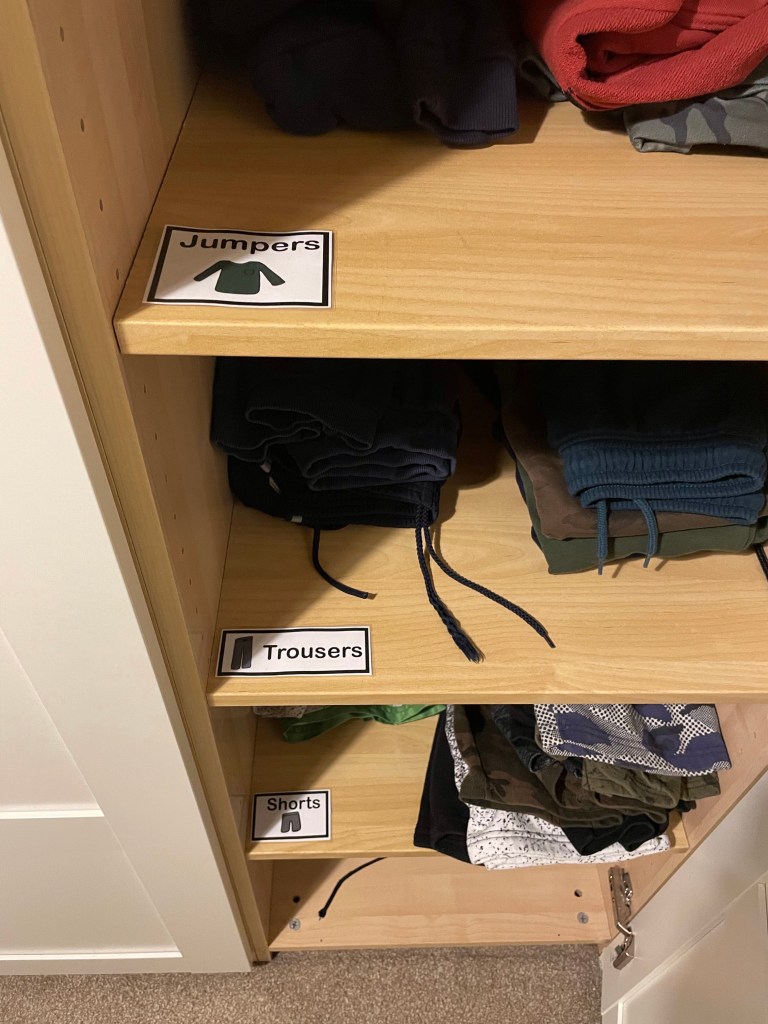
Labels for clothing

Labels for clothing – These labels are for a dual purpose. Mainly as a reminder for what he needs to wear, linked with a routine chart (coming later). But also at the moment if you ask him to tidy up, he literally can’t remember where each item goes. Jumpers end up with the trousers and so forth. I don’t mind if they are not put on the shelves properly, but it would be good if they were on the right shelf.

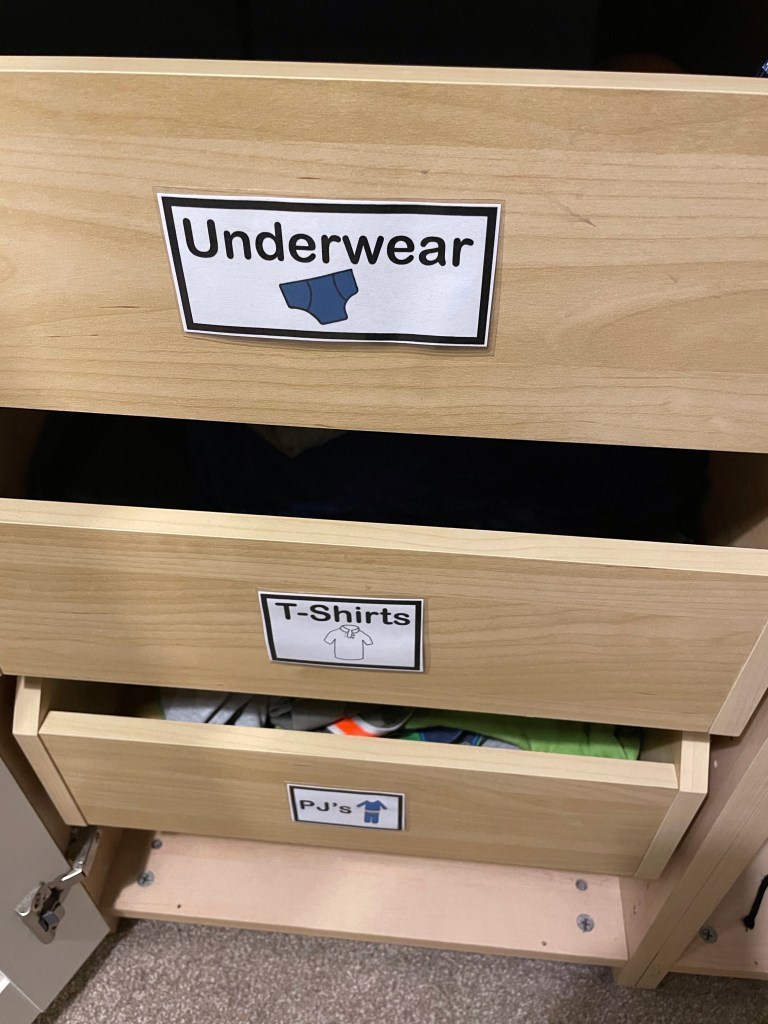
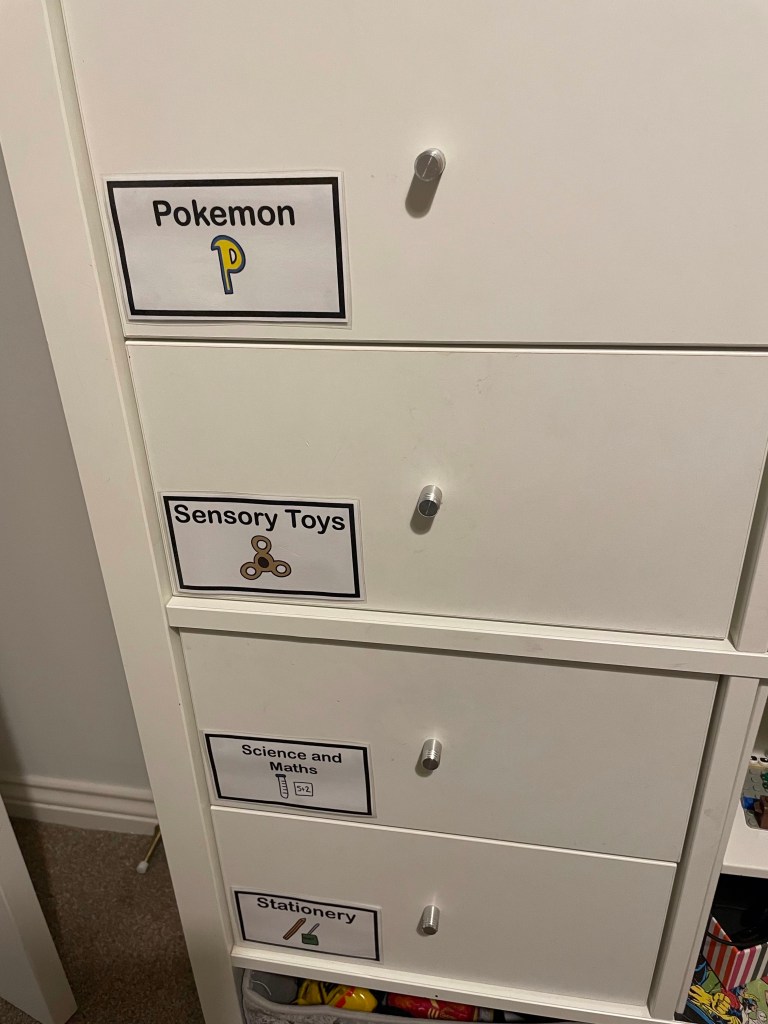
Drawer labels

Drawer Labels – At the moment he struggles to know what to play with. It’s important for all of our sanity that toys are tidied away. He would love it if toys were stored all over the floor. But that is just not possible. But the problem with keeping things tidy is that everything is hidden and therefor he doesn’t bother. He won’t think I want to play with that or that. He just doesn’t go looking. He can’t remember what he has. So drawer labels help him to know what he has, but also to know where to put things after.

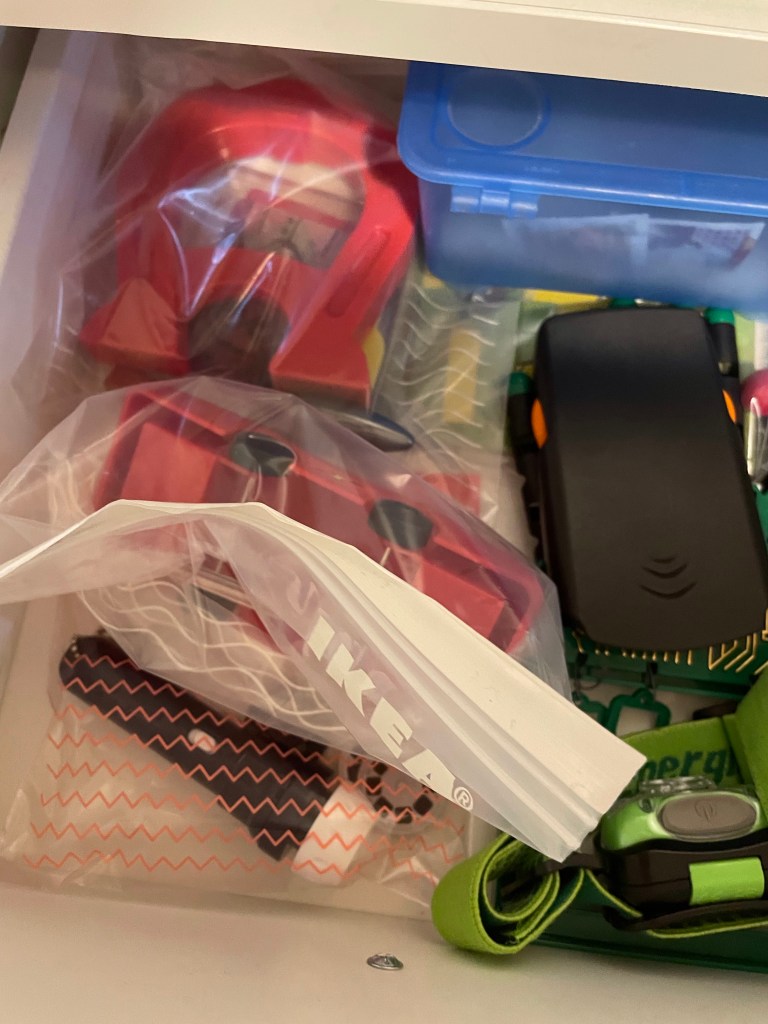
Everything is put into categories

Keep joint items together – Each item in this drawer if it has many bits are put together in a bag. Someone with ADHD won’t give something the time of day if they have to hunt for all the pieces. I’ve labelled each bag, but thats mainly for my benefit.

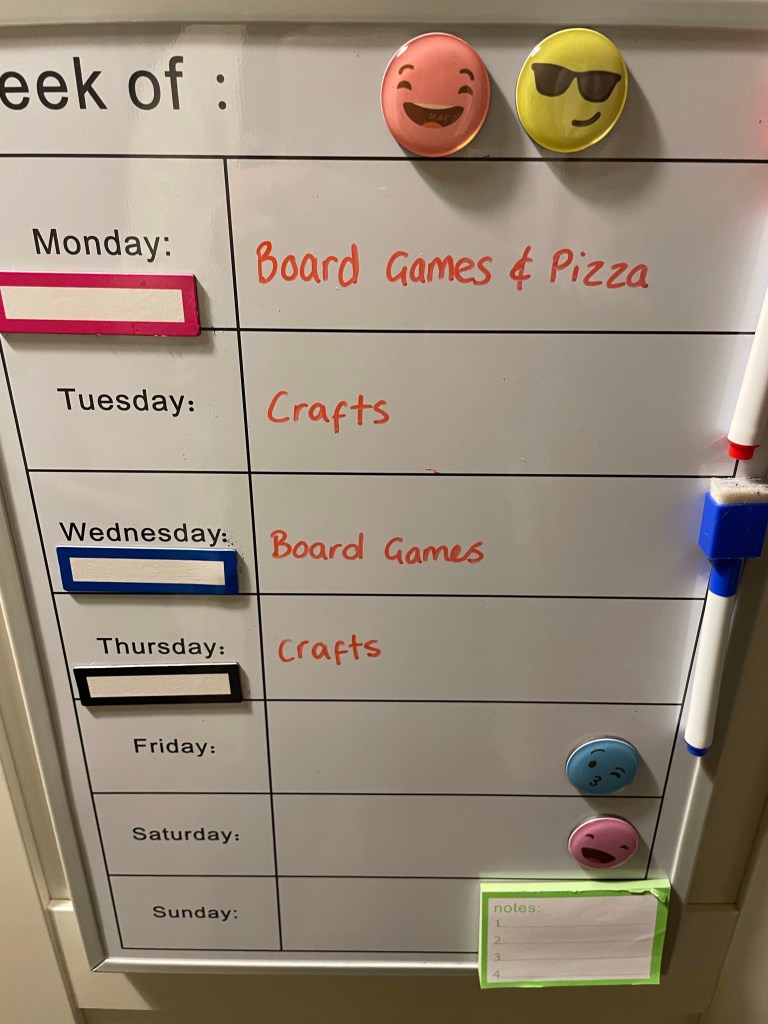
What’s happening this week

What’s happening this week board – In a previous blog I spoke about how children and Adults with ADHD see time. It’s not linear it’s just a jumbled series of events and how those events make them feel. This is updated weekly so he has quick access to what is happening during the week. He also gets time to process that certain activities that he doesn’t like as much are happening.

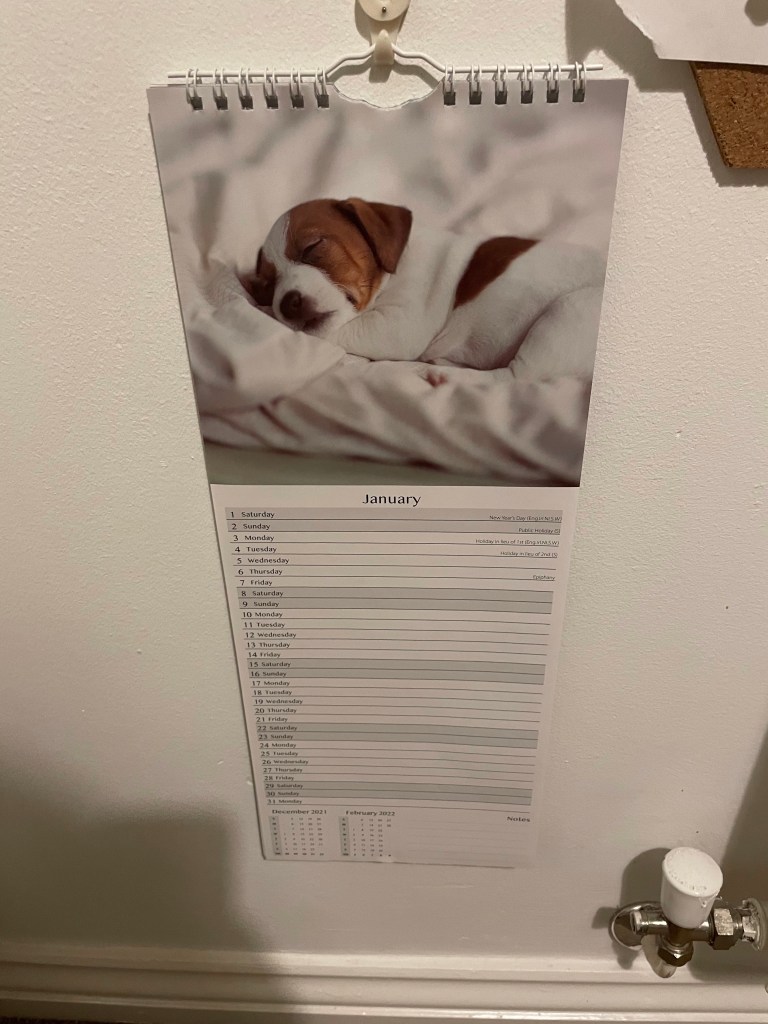
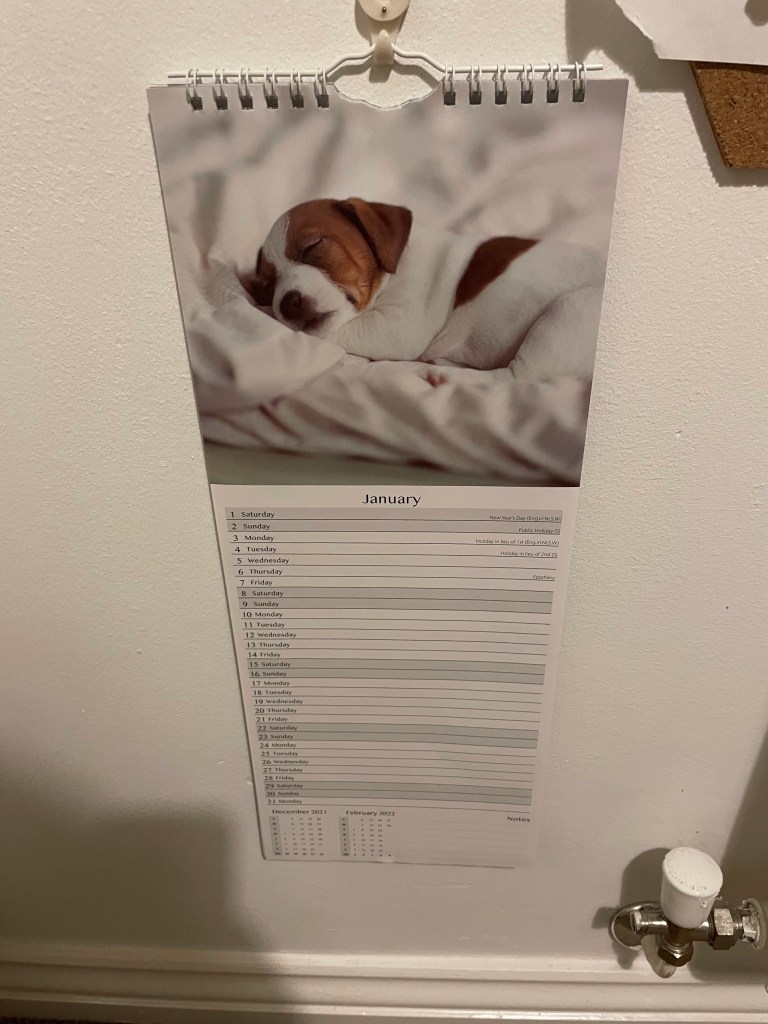
Calendar

Calendar – The calendar will again help him realise where in time we are and hopefully get him to realise the linear nature of time. I don’t want to wipe out the way he see’s time as I imagine it’s quite a wonderful way of looking at the world. But this will help him work in the way that most people do.

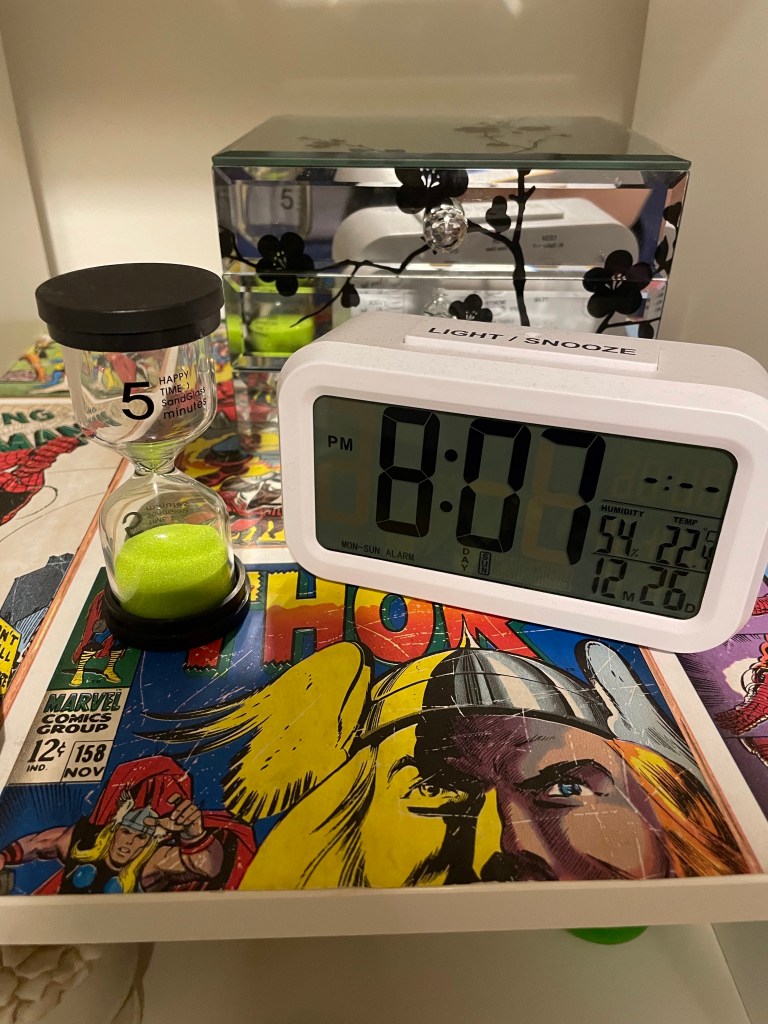
Clock and Timer

Clock and Timer – These are important things in our life. We bought a clock that tells him the time and day, but I also need him to realise what time it is. For example we start getting ready in the morning at 8am, this is so he can realise where we are in time. The timer is also a great tool, it keeps him focused. The other day I didn’t use any of the strategies (don’t ask me why!) and after about 10 times of asking him to get dressed I found him on the bed looking at something. When I asked him to get dressed again he said “O you wanted me to get dressed!” So out came the timer again!!

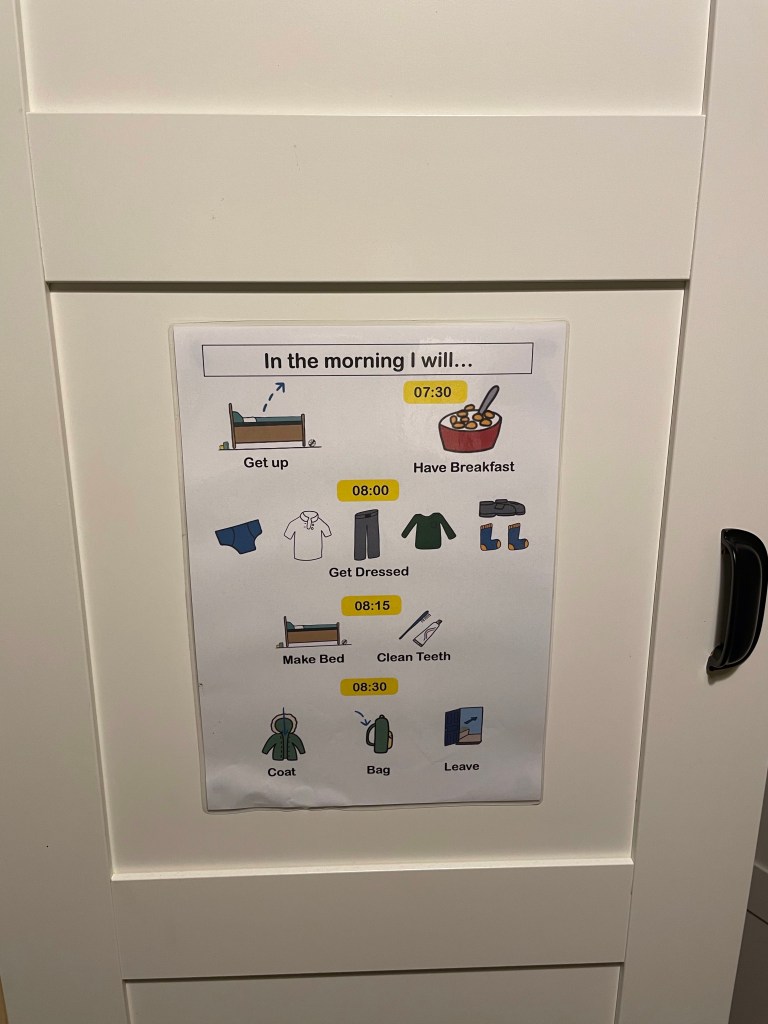
Morning Routine Chart

Morning Routine Chart – I’ve talked about this a lot, so won’t go into detail. But as you can see the labels in his wardrobe match the routine chart. So there is consistency.

I hope this helps you on your EF journey. I also hope it helps us on ours.

What does time look like?

This is something I have spent a lot of brain power on lately. How does my little one (who probably has ADHD) perceive time?
I’ve always found it so funny that someone who is quite clever and can work out maths sums in seconds cannot for the life of him work out what day it is, or what day is coming next. Then when it was my husbands birthday, my son asked when is your next birthday? It was in that moment that my suspicions of struggling with Executive Functioning were confirmed.

So I went on a search to find out what does time look like? Now I am very aware that there is a much deeper, philosophical answer to this than what I am about to give you.

Firstly what does time look like for people who don’t struggle with Executive Functioning. For me it’s a straight line, or like a time line the ones you see in history books. The past, the present and the future all spread out in a colourful line. It’s all clear, it’s all visible and its all colour coordinated (but then that is just me!).

But as Sandy Maynard M.S in this great article writes:
Some experts think that individuals with ADHD perceive time not as a sequence but as a diffuse collection of events that are viscerally connected to the people, activities, and emotions involved in them. That often means they’re always late. Children and Adults with ADHD don’t see events they feel them.

And this is what I have witnessed in my little one. It’s all about now, or what is coming up next, but he doesn’t understand quite where the next comes in. There might be things that need to come first, but that doesn’t take priority. Understanding that you have to get dressed before going out and making time for that. Or getting so lost in time that there is no awareness where he actually is in the current time.

I get it, he’s still young, but what I am realising is this is something I need to teach him. I need to put in place strategies that will help him. Some children just learn this intuitively and some children need to go back to basics. Which means we as the parents have to go back to basics and realise how do we do things. We need to break it down for them to help them make sense of it all.

A calendar to help realise how time is linear

Planning!!

This word sometimes sends people into a panic! But it doesn’t have to.

People who have ADHD or Dyslexia can find it really difficult to organise their thoughts, their day or their week.

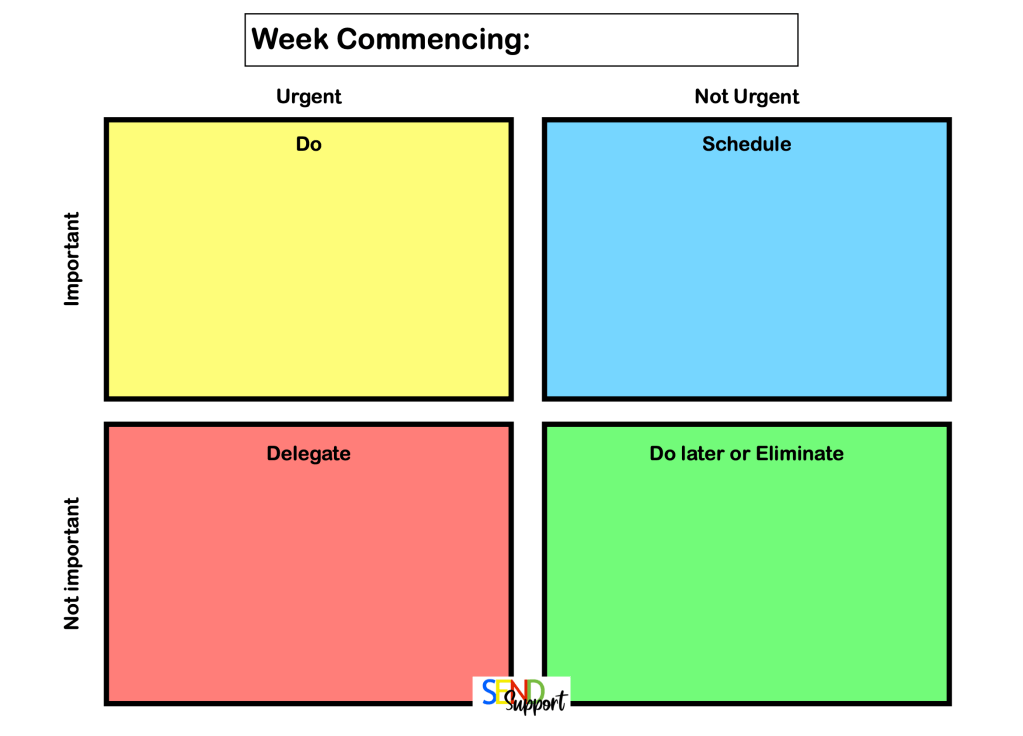
Today after feeling overwhelmed about what order to do all my jobs in, I came across Eisenhower’s Priority Matrix. It essentially helps you to work out what is a priority and needs doing now or very soon or what can be done much later or can be eliminated altogether (I haven’t been able to put anything in that box yet).

All you have to do is sit down and think through everything that needs doing. Each job that needs doing, you allocate it to a box. I know that all the jobs I write in the yellow box needs doing this week at the latest. Then it gradually gets less pressured as you move into the other boxes.

So if you are struggling to be able to put some order in or even if you don’t have Dyslexia or ADHD but are just really busy. Give this a go. It might really help.

Here is a free download for you to print off.

ADHD type characteristics

First let me explain the title. We have fought a long battle to try and get an ADHD diagnosis for our child, and it seems to go nowhere. This is for a number of reasons that we don’t need to go into. But basically I may never get a piece of paper saying my child has ADHD, but it doesn’t mean that I am not going to support him. And the way we support them is in the same way you might help a child who is diagnosed with ADHD. You may also have a child who has ADHD characteristics but doesn’t meet the threshold for diagnosis or you may just have a child that is fast, lacks focus and gets easily distracted (sound similar!)

I have pulled my hair out with my child’s behaviour over the years, and maybe this may help you to keep some of your hair. These are just a few ideas we have come up with over the years that have helped and I have also used in my work as well.

Rewards and Praise before consequences
Now I am not saying here that your child should not face the consequences of their behaviour, but before it gets to that point try rewards and praise. Children with ADHD respond so much better to praise and rewards than shouting and consequences. I find in my not so great moments that when I do shout his behaviour gets worse and it spirals. So try some of these first as a preventative measure.

Marbles in a Jar
The key to rewards and praise is looking out for the good behaviour rather than always dealing with the not so great behaviour. Techniques like marbles in a jar helps you to focus on the good behaviour. So every time you see some great behaviour even if it is really small put a marble in the jar. Every morning empty the jar and talk about the jar together saying we want to see this jar full by the end of the day, can you do it? Seeing the jar full is in itself an intrinsic reward. If you wanted to up the joy, you could say that if the jar is full every day for 7 days we can have a small treat, which adds to the praise and rewards. This is so helpful for you as a parent/carer because it makes you look for the positive and over time your mindset will change. But it supports your child, because they are being praised regularly throughout the day rather than being told off a lot.

These next two examples are exactly the same principle just different ways of showing it.

This needs some preparation, but it is colourful and fun! (Maybe best for slightly older children because of the use of magnets) Each pom pom has a magnet glued onto the bottom. The rainbow sheet which has been laminated is sitting on a metal baking sheet. Every time your child does some brilliant behaviour even if it was they said please or thank you. Put a pom pom on the rainbow. Can they fill the rainbow by the end of the day. You can download the rainbow print out below.

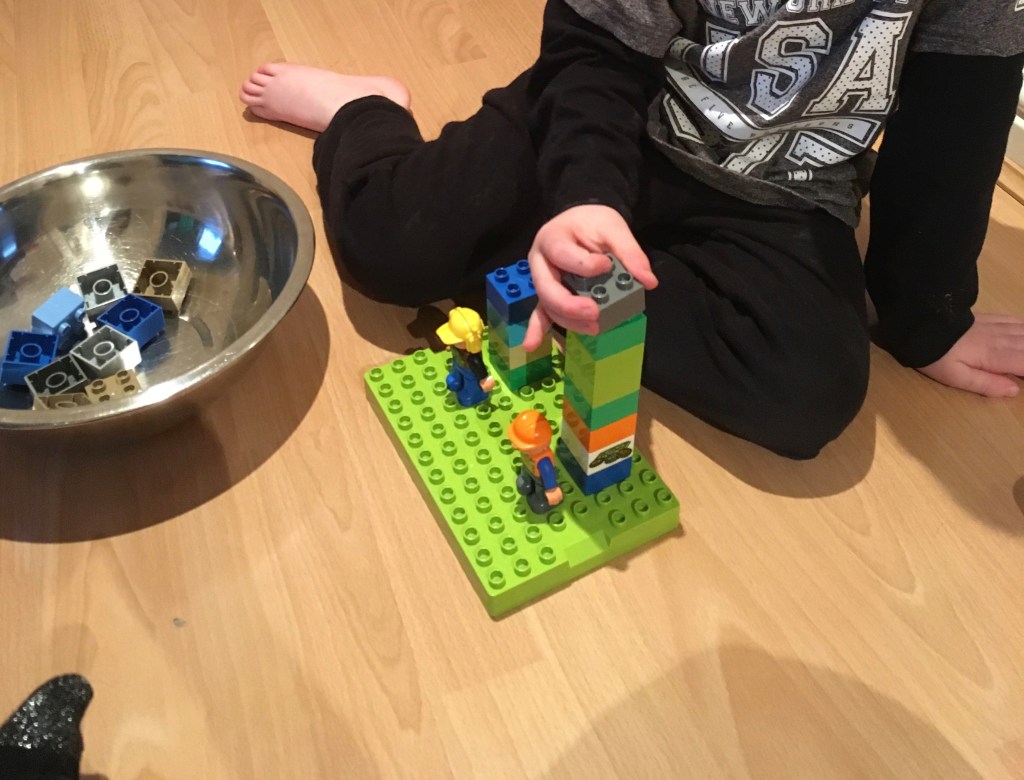
If your child is into lego or Duplo then use the Lego to make a tower. How big can the tower get? Fill a bowl with bricks every morning and see if you can use them all.

The important thing with this technique is not to take away. So if they show some not great behaviour then deal with that separately. This is all about rewards and praise.

Brain Breaks
Before entering into homework time or something that is going to require sitting still or focus. We have often gone on a run or walk first or before needing to sit still for a while we have been to the skatepark or the park first to burn off some of that excess energy. But particularly before homework time we go out for a walk. You can use this time to talk about the expectations you have for the homework time coming up, what you will do and how long it will take. But mainly this time is for letting off some steam before sitting down. It doesn’t always work, but I have noticed a difference when we have done it and when we haven’t. Or say you’ve gone to a wedding or round someone house, which isn’t completely set up for an active bean, then regularly go for a little walk outside. This will do you both the world of good and it takes the pressure off your child. We recently went to the theatre, it was an hour long show and instead of me expecting him to sit through it for the whole hour I set in my mind that at the half way point we would talk a short walk. The walk was 1 min, but that change of scenery and getting up completely settled him and he was able to enjoy the rest of the time.

Activity and Challenge
I also find that sometimes the best focus comes whilst he’s concentrating on something else at the same time. No I am not meaning watching a screen whilst testing timetables. But maybe jumping on the trampoline whilst shouting out the 3 timetables or during lockdown we took to reading a book whilst jumping.

I watched a programme once where a child played table tennis whilst revising for a history test. It may seem counterproductive to get them to do other stuff, but I think it takes the pressure off. It’s the same principle as using a fidget toy, but a whole body work out.

Where this type of thing isn’t possible, then fidget toys are brilliant. You can readily get hold of fidget toys on the high street now. Another great thing (again for older kids) is letting them have blu tac or play dough to play with whilst working or kinetic sand. Just gives them that outlet.

I guess what I am mainly trying to say is that in some ways it is better to embrace their ADHD characteristics instead of always fighting against them. There are times in life where you have to fight against them. But there are also times where you can work with them and it’s finding that balance.