Mothers Day verses Birthday

After Mothers Day I posted on FB that it hadn’t been the best day.
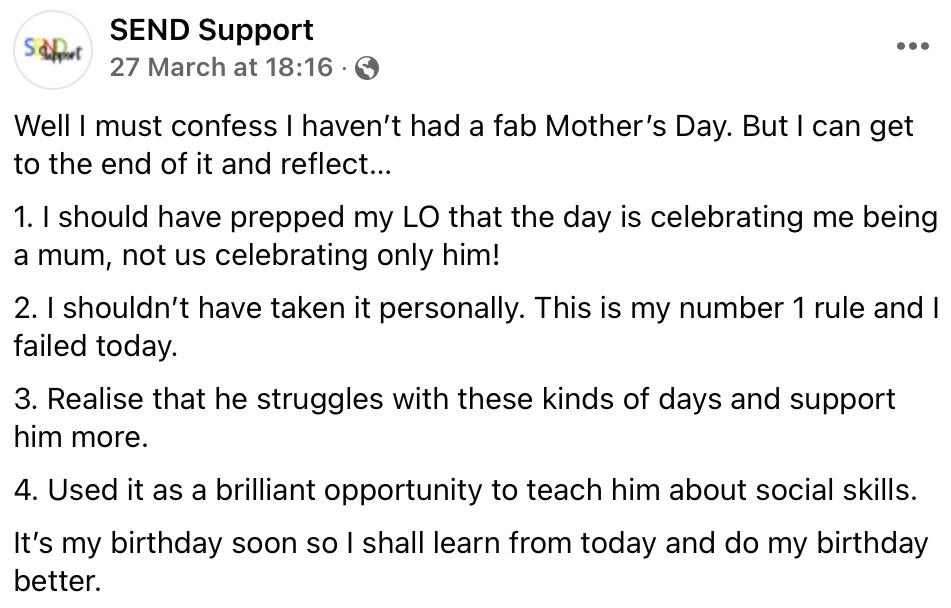
It hadn’t been great because my little one hadn’t been prepped at all about a different day and not only was it different, it was about me and not him!

So I challenged myself to have a better birthday and I can say it really was a great day. But to get to that point I had to put in some work. But it really was worth it!

1. Prepping for the day
This started the day after Mother’s Day. I was determined for it to be different. And it just started with conversations. Conversations about my birthday coming up and how birthdays are important days for some people and on those days we should treat them well and treat the nicely.

My husband also took him out on a special trip to buy me some presents. My husband used the opportunity to say that Mummy probably wouldn’t want a rocket for her birthday, can we think of some things Mummy might want!

We talked about it quite a lot, and expressed regularly how he needs to behave.

Because my birthday was during the holidays, we made a holiday picture time table and my birthday was part of that.

2. Taking it personally
This is such a hard one. It goes against everything in you. If any adult or Neuro-typical child behaved in the way my little one did, you definitely would take it personally and you probably wouldn’t speak to them for a while, because you thought they were quite mean, and unthinking.

But as our ADHD nurse put it, you have to reframe it. It’s not him being mean and horrid (even though it is), but he doesn’t understand, he doesn’t know how to do this right, because socially speaking those skills are not honed yet. In some ways the whole day would have been far better if I hadn’t taken it personally. If I’d have realised all of this in the morning and not at my bedtime! If I’d taken it in my stride, then we would have had a better day. For my birthday I was half expecting it to go very wrong, so in some ways it was a complete shock and surprise when it didn’t. I altered my behaviour and tried to help him alter his.

Now I’m not saying his behaviour on Mother’s Day was acceptable. And at some points in the day there were some consequences for his behaviour. But like with all behaviour, we have to ask why? When I reframed the situation, I wasn’t as insulted and put out. Try it next time you’re in a similar situation. I hope it helps.

3. He struggles with these types of days.
We recently met with an ADHD nurse and she said something that hit me like a ton of bricks!!

“Children with ADHD don’t like CHANGE!!”

Now yes I should know this, but it’s never been said in such a clear way. Now Mother’s Day is definitely a change. It’s not part of the norm and it’s very different. This is the same for children with ASD and other neurological conditions.

So you can either give into this and say well we won’t celebrate it let’s just keep everything the same and then you as the mum miss out (again!) or you can allow it to happen and either face the consequences or prep. I personally as the mum don’t want to miss out. I work so hard at being a Mum, I want to celebrate this fact!!

4. See it as a brilliant opportunity to teach social skills.
This is not going to be the only time in his life where he will have to put someone else first. As a child his friends will have birthdays, his family will have celebrations and when he’s older and gets married and has children, that’s a whole lot of putting others first. So this has got to be taught.

We’ve always had to break social skills down into small basic chunks to support our little one. And this should have been no different.

* Putting others first
* Respect others and their feelings
* Understanding how celebrating someone else might make them feel loved and special.
* Why we have special days
* These types of days are a regular thing

Now of course you don’t teach all this in one go. But you drip feed little nuggets. The very act of prepping shows that this is important. It takes time, it might take a few years of it not being great. But have hope!!

ADHD and Covid

I know I am a bit late to the party, but I didn’t confidently feel I could write about this until really having to deal with it.

Covid has rocked all of our worlds in one way or another. For some it’s been the push they need to make big decisions and for some its completely put a stop to things.

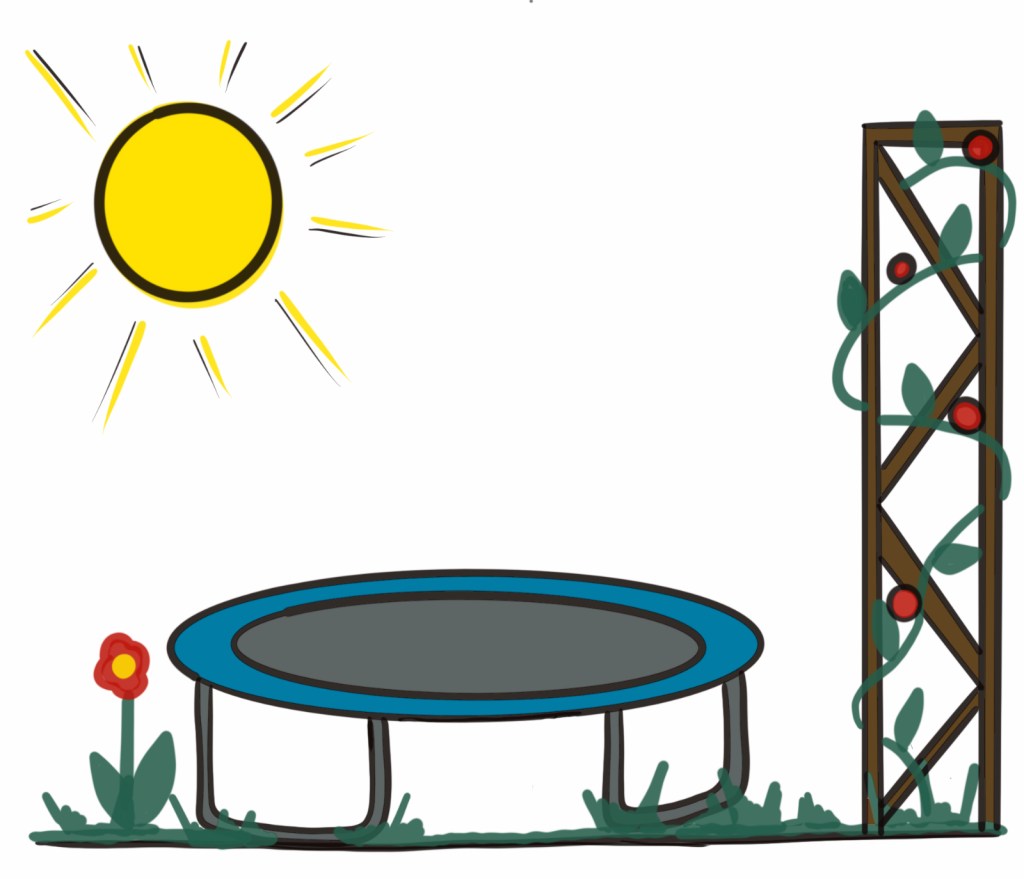
For us covid has had a number of impacts some not great and some great! When it all first happened, we realised that our support networks for our active bean (my son) were things like swimming, gymnastics, the indoor skate park, the trampoline park. These were the things we used to survive on a daily basis. And these were all taken away as soon as Covid arrived. This was a disaster for us. Plus we lived in a second floor flat, so getting outside and getting exercise or at least the amount of exercise needed was tricky. So for a while it was bad! What was good is we were able to ask for help from the school and it finally gave us the push we needed to move to a house with a garden and a trampoline. Which has made a significant difference.

We’ve been able to get back some normality as the time has gone on, we’ve gone back to the trampoline parks and the skate parks and weekly gymnastics.

But then my active bean got covid recently and had to self isolate for 10 days. All my fears were realised, I have dreaded being in for that amount of time. We’ve never done it. But although it wasn’t as bad as I thought, it did get me thinking. Especially as when track and trace call and ask if you need any support and the women got a diatribe about how we need to do more about support adults and children with ADHD whilst self isolating (I’m not sure she knew what to make of it).

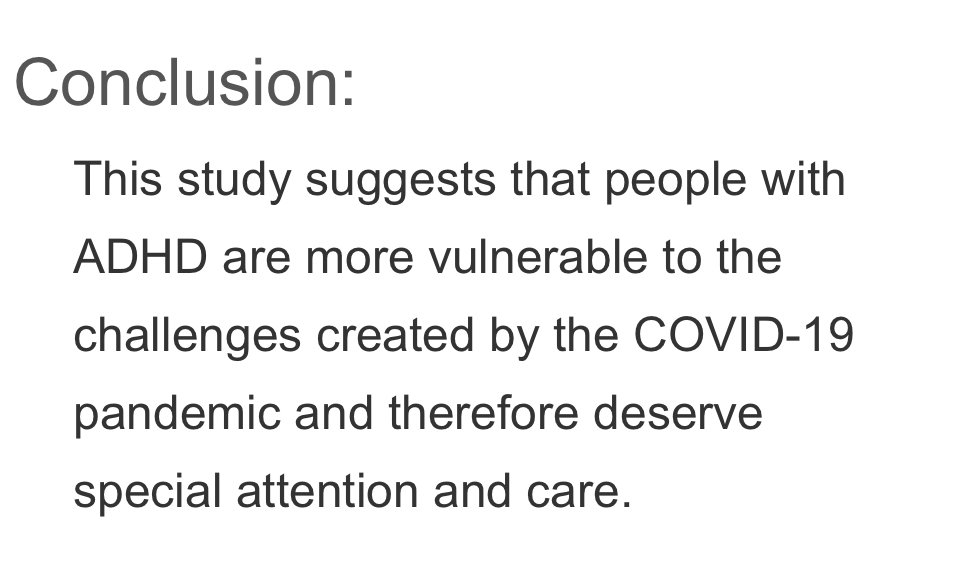
I then read a research article about covid and ADHD (I’m so sorry but I can’t find it again) but the conclusion was this…

So what are some of the challenges? and what can be done?

1. No exercise – during lockdown at least we could get out for at least an hour a day (no way near enough, but it was something). But when self isolating there was no way we could leave the house. Annoyingly it also rained a lot so the garden was off limits too.
Answer One day we did a lot of running on the spot, another day we joined in a session of Apple fitness. Another day he just slid down the stairs a lot!

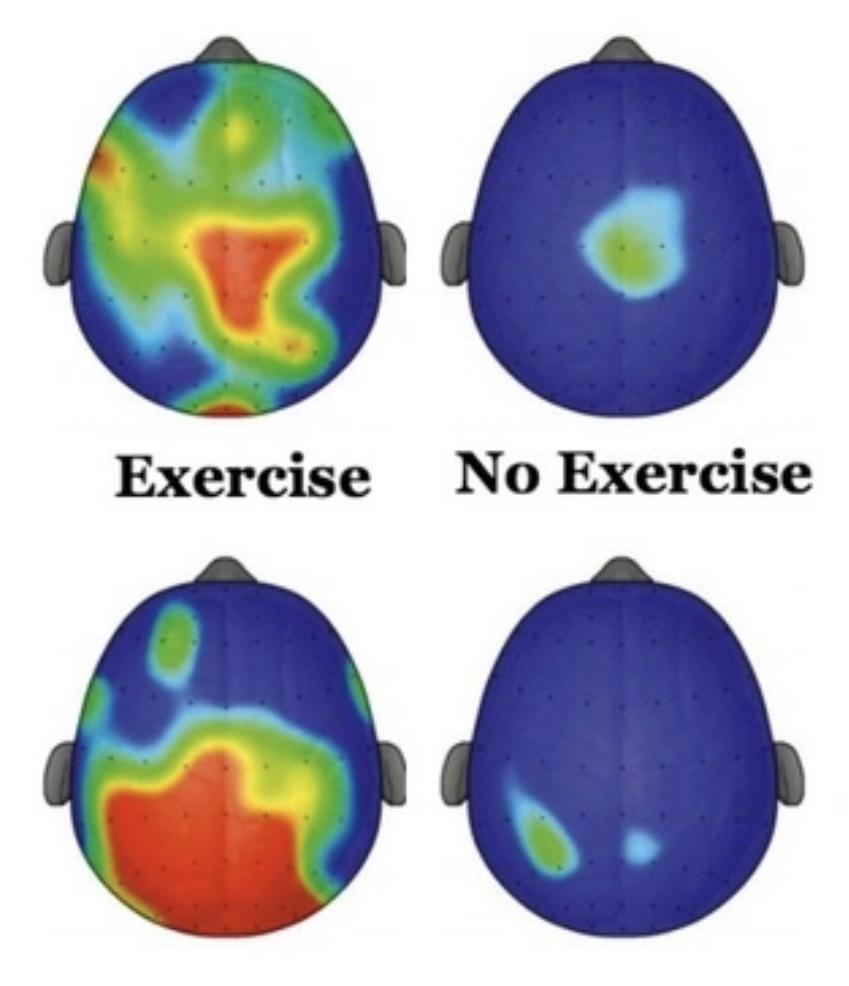
Another research article I read supports the absolute need for physical activity. They scanned peoples brains who have ADHD and after physical activity they were able to have the greatest amount of executive control.

The red represents the greatest amount of executive control and blue represents the lowest.

We find this so much in our every day life, after school we have to go out on some massive run or climb or something to allow him to unwind and then the evening is better. So if in self isolation make time for physical activity. Carve out the time, if you have a child with ADHD find a fun way to make room for at least 10 mins of physical activity, life will feel a bit better.

2. No structure – There was no structure for us, it was the Christmas holiday, so we didn’t have to do home learning. We also obviously couldn’t see family or do all the things we’d planned so that was difficult. It was our decision that we wouldn’t have restrictions on screen time, but we did try to plan in at least one activity a day. I must confess that this was tricky, but we did manage it. We used the joy of amazon to buy in new activities such as Polymer clay or games, and we enjoyed a lot of cake and watched films together.

3. Cabin Fever – This did get to us, especially my little one. By 5pm most days he would be having a melt down. So we began to plan things in for around this time. Fire pits (If it wasn’t raining) or a nice dinner. But mostly we were just with him in the melt down.

The reality is self isolating with someone with ADHD is tricky, self isolating with someone without ADHD is tricky.

Some things I wish I had done.
1. Forced garden time each day – this may have helped getting some fresh air.

2. Not done the day 6 & 7 test – he was so upset and disappointed when we tested on day 6 & 7 and found he was still positive. So in a way I wish I would have just stuck it out.

3. Transitioned for day 10 – He was really anxious about leaving the house when he actually could. I wish I had done a picture timetable to help that transition.

4. Support sensory needs – In some way I think I should have created a calm down sensory space.

But hopefully my wish list might give you ideas if you ate in the same situation.

Meal Times

I was asked this week by a family to support with meal times.
Meal times can be tricky for all families and all families do meal times differently, which is completely fine.

But however you do, do mealtimes there may be some common difficulties we all face. These difficulties arise for many, many different reasons but some of them can be:
1. Your child has ADHD or is just a fidget and getting them to sit at the table is hard.

2. Your child has ASD or sensory issues which makes eating certain foods tricky.

3. Your child is colourblind and basically a lot of food looks yucky

4. Your child is a child and meal times just become a battle ground.

As with all my posts, take some of the ideas and that you think might work for you and leave the rest. Or let my ideas spark new ideas that may work for your family. But know if you are struggling with meal times then you are not alone!

Trying new foods
I never wanted to broach this subject with my little one because to be honest I just couldn’t face it. But when it got so bad, I knew I had to try. And really its just forming new habits (If you say it like that it seems easier!)

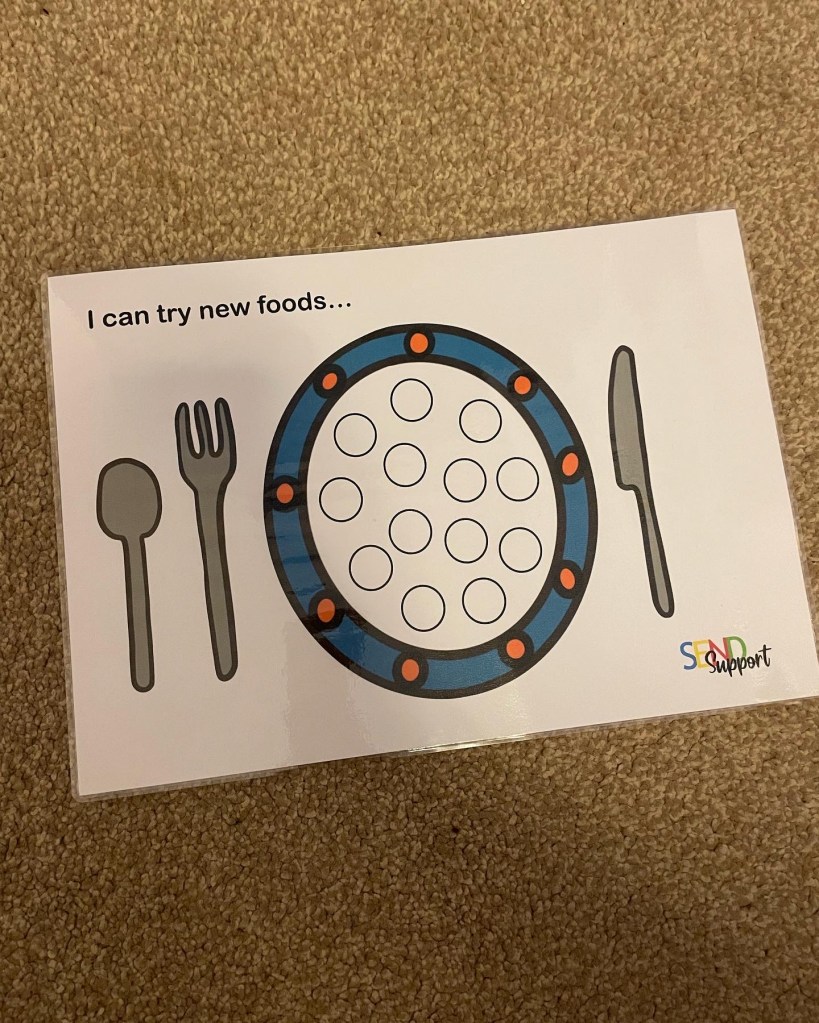
The main way we worked on this was to serve up his normal food and on the table I would keep a reward chart. I would then put something new on a plate to the side of his dinner. Every time he tried a new food he got a sticker. He knew the rules and I would just put the new food on the table, but would not go on about it. We would talk about our day and try and have a normal dinner time, but we wouldn’t mention the new food. But as soon as he tried the new food he would get a sticker. As soon as the reward chart was full he got a reward. We did the chart a few times over and gradually food didn’t seem so scary. I’m not going to lie and say that he now eats everything far from it, but food isn’t so much of a battle and his repertoire has increased.

Meal Times are a battle
It’s so easy to get worried about what they are eating or not eating, that, that is what meal times become about.
I have such fond memories of meal times all sitting round the table chatting about our days and then my dad making teeth out of the orange peel!! But meal times in our house became about me being stressed out and meal times being horrid. So try different things to take the focus away from the food.

Games
Pass the story
We would play the story game. One person starts the story then passes it to another to carry it on and so forth. We had some fantastic stories come out of these times and no one really realised they were eating food.

Play would you rather
This game begins with ‘Would you rather…’ You then say two different things like – eat cold baked beans or sit in a bath of baked beans. And everyone around the table has to choose what they would rather.

Conversation starters
Have a jar on the table with a bunch of conversation starters in. If you feel like the meal time is becoming about the food then take out a conversation starter and see where it takes you. This can be also a great idea if you have a child you likes to bring the conversation back to his latest obsession. (There are only so many tea times you can talk about hand driers – believe me!)

Sitting at the table
We do not have expectations that our child sits at the table for a long time. But we do expect that whilst he is eating he has to sit down. This is a constant battle for us.
– Friends of ours have tried the wiggle cushions and says it works for them.

– We take the approach that if he gets up there’s no pudding, but this is tricky, because with children with ADHD the impulse to get up over rides the outcome. So I have started putting a visual on the table of a person standing up with a line through it as a constant concrete reminder.

– There are times like going to other people’s houses for dinner (Not something we do regularly) or going to a restaurant where sitting is a social convention. I make sure I take activities and fidget toys and I am really clear with our child and the people we are with about how long realistically the sitting can last.

But if all else fails. Just end the meal time and start again the next day. You want meal times to be a half lovely time for your family not a battle ground.

I hope there are some ideas that help.

Creating a bedroom that supports Executive Functioning.

I’ve been wanting to make my little ones bedroom work for him. Especially in the area of Executive Functioning (EF). So using the opportunity of self isolation I’ve been given the time.

Some of the different things I have already talked to you about in other posts, but here it is all in one place. I’ve used the context of the bedroom as a base for all of these different strategies, but they can be used in any room. You just need to decide what works best for you and your family.

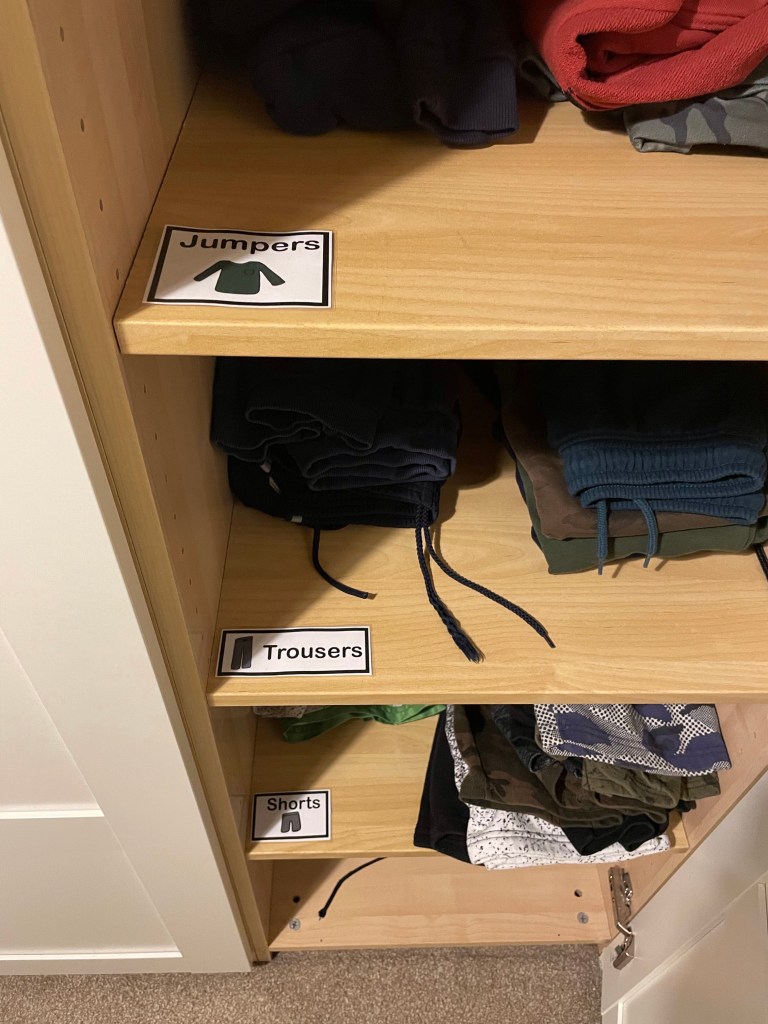
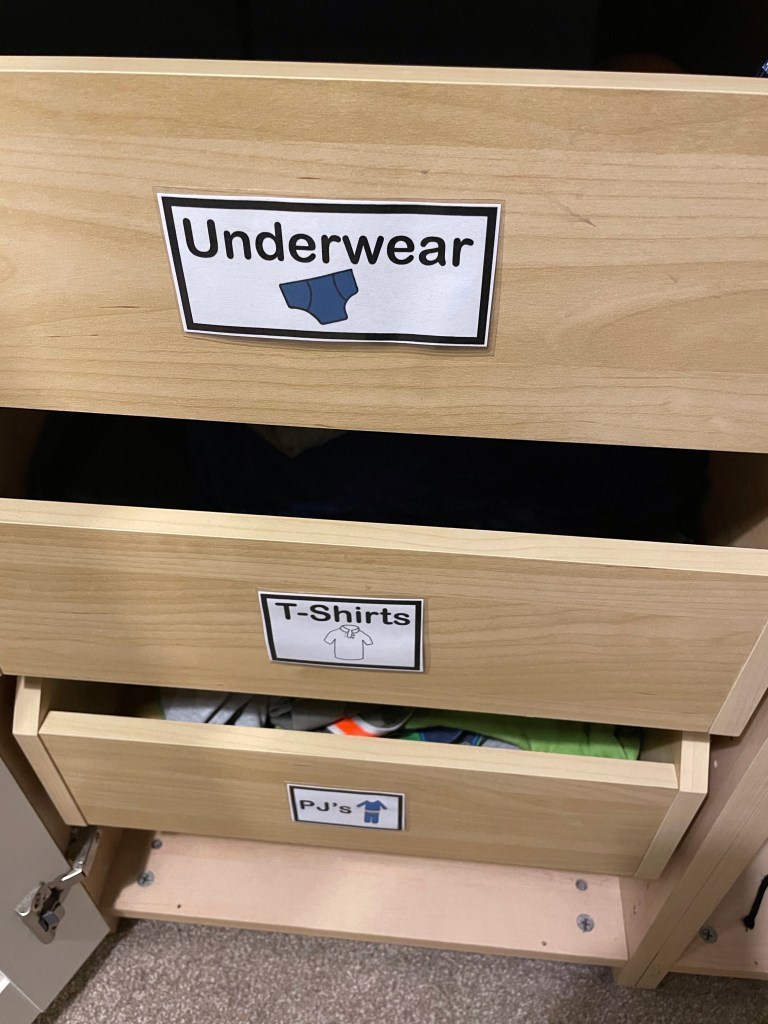
Labels for clothing

Labels for clothing – These labels are for a dual purpose. Mainly as a reminder for what he needs to wear, linked with a routine chart (coming later). But also at the moment if you ask him to tidy up, he literally can’t remember where each item goes. Jumpers end up with the trousers and so forth. I don’t mind if they are not put on the shelves properly, but it would be good if they were on the right shelf.

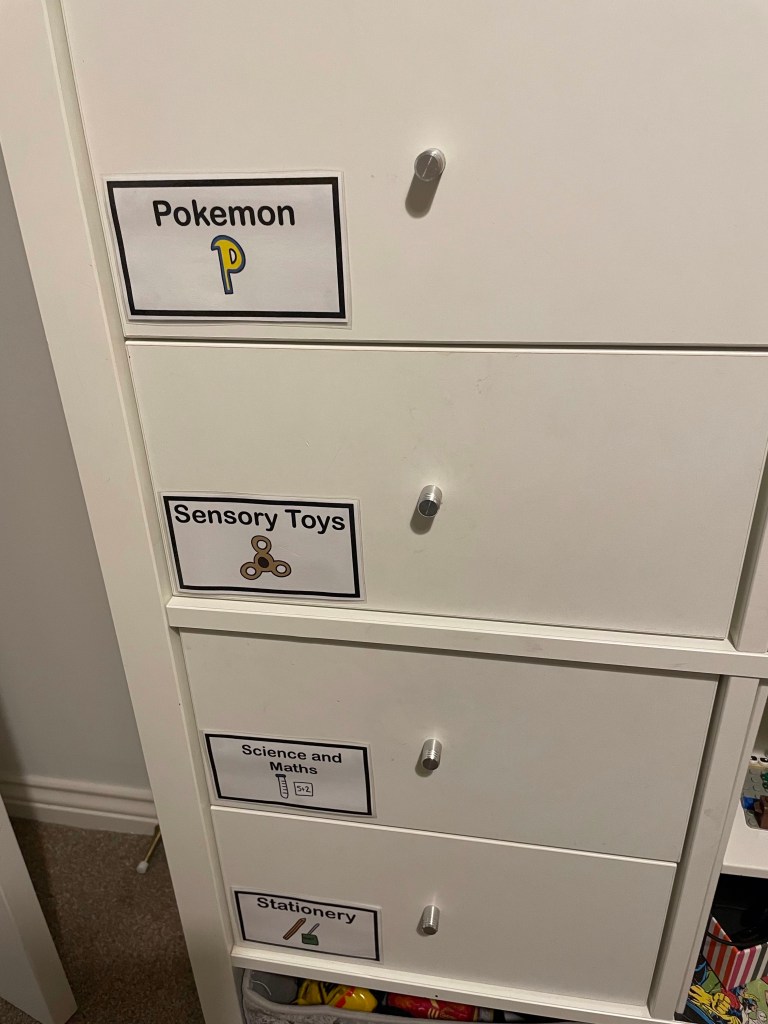
Drawer labels

Drawer Labels – At the moment he struggles to know what to play with. It’s important for all of our sanity that toys are tidied away. He would love it if toys were stored all over the floor. But that is just not possible. But the problem with keeping things tidy is that everything is hidden and therefor he doesn’t bother. He won’t think I want to play with that or that. He just doesn’t go looking. He can’t remember what he has. So drawer labels help him to know what he has, but also to know where to put things after.

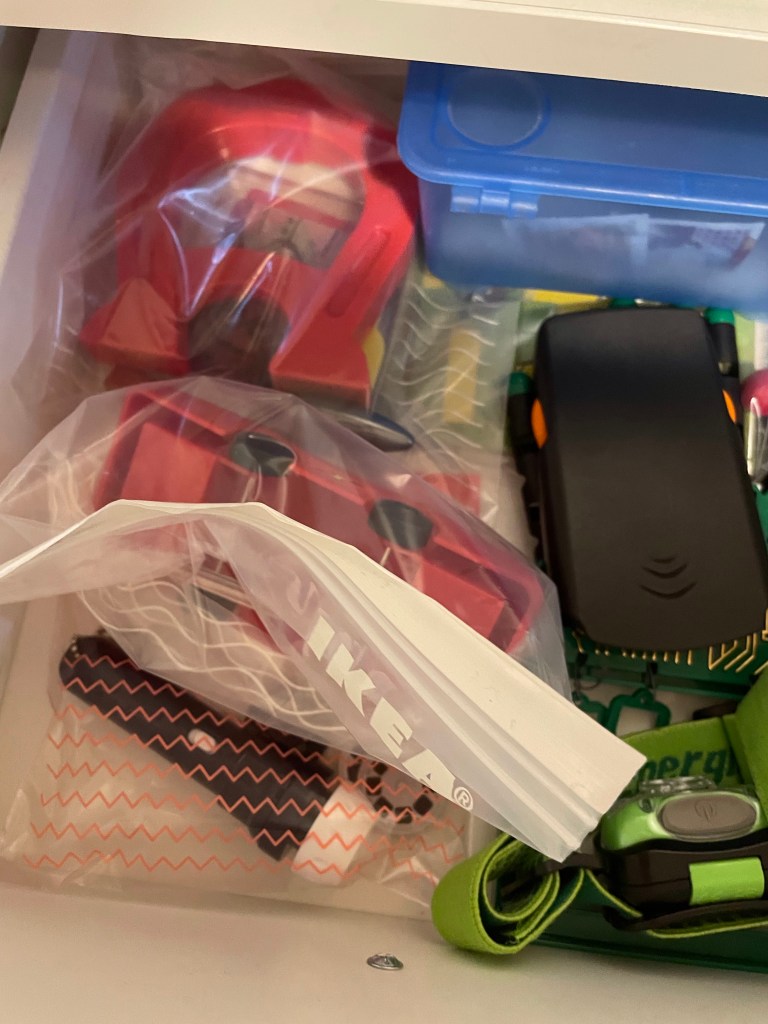
Everything is put into categories

Keep joint items together – Each item in this drawer if it has many bits are put together in a bag. Someone with ADHD won’t give something the time of day if they have to hunt for all the pieces. I’ve labelled each bag, but thats mainly for my benefit.

What’s happening this week

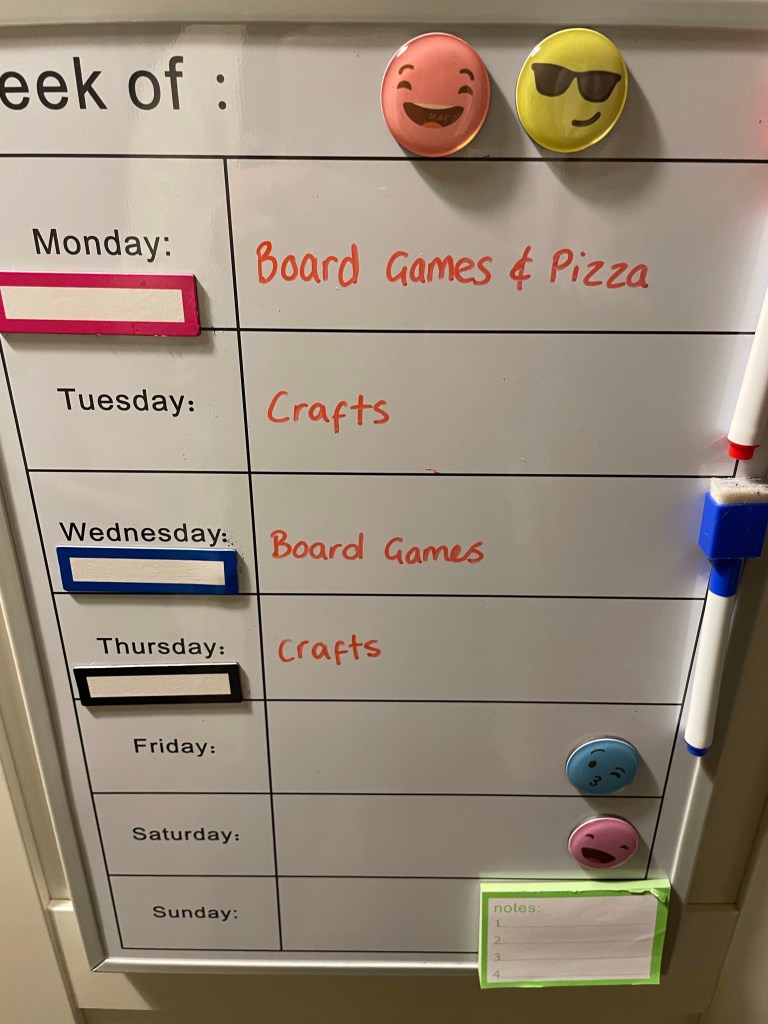
What’s happening this week board – In a previous blog I spoke about how children and Adults with ADHD see time. It’s not linear it’s just a jumbled series of events and how those events make them feel. This is updated weekly so he has quick access to what is happening during the week. He also gets time to process that certain activities that he doesn’t like as much are happening.

Calendar

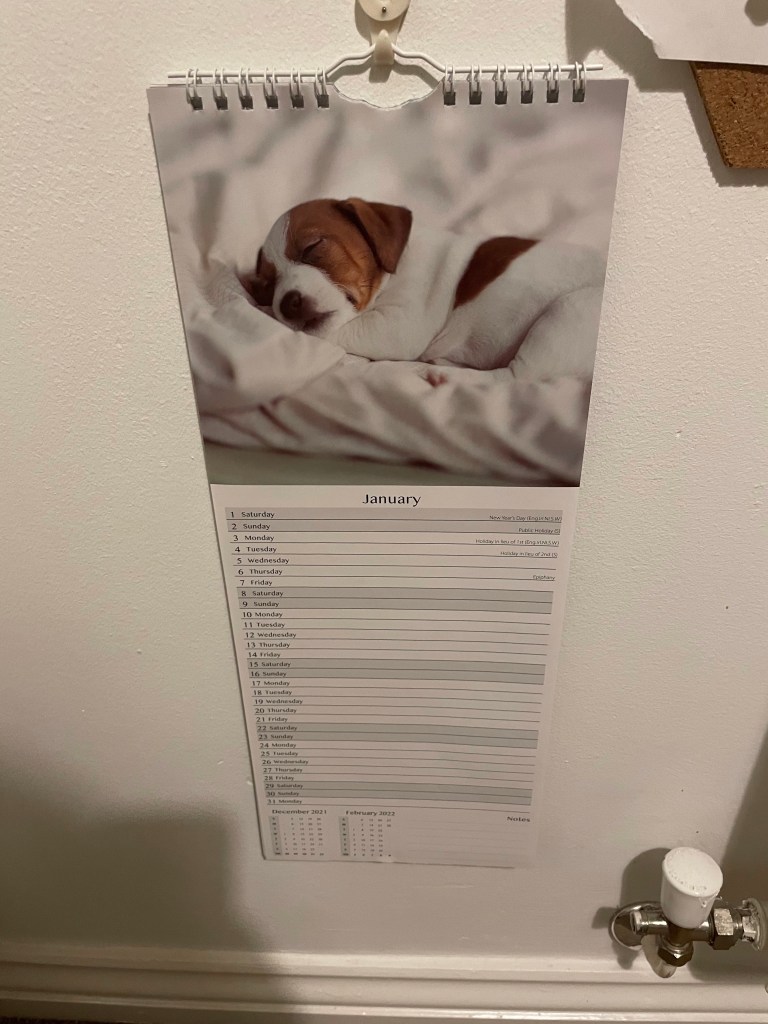
Calendar – The calendar will again help him realise where in time we are and hopefully get him to realise the linear nature of time. I don’t want to wipe out the way he see’s time as I imagine it’s quite a wonderful way of looking at the world. But this will help him work in the way that most people do.

Clock and Timer

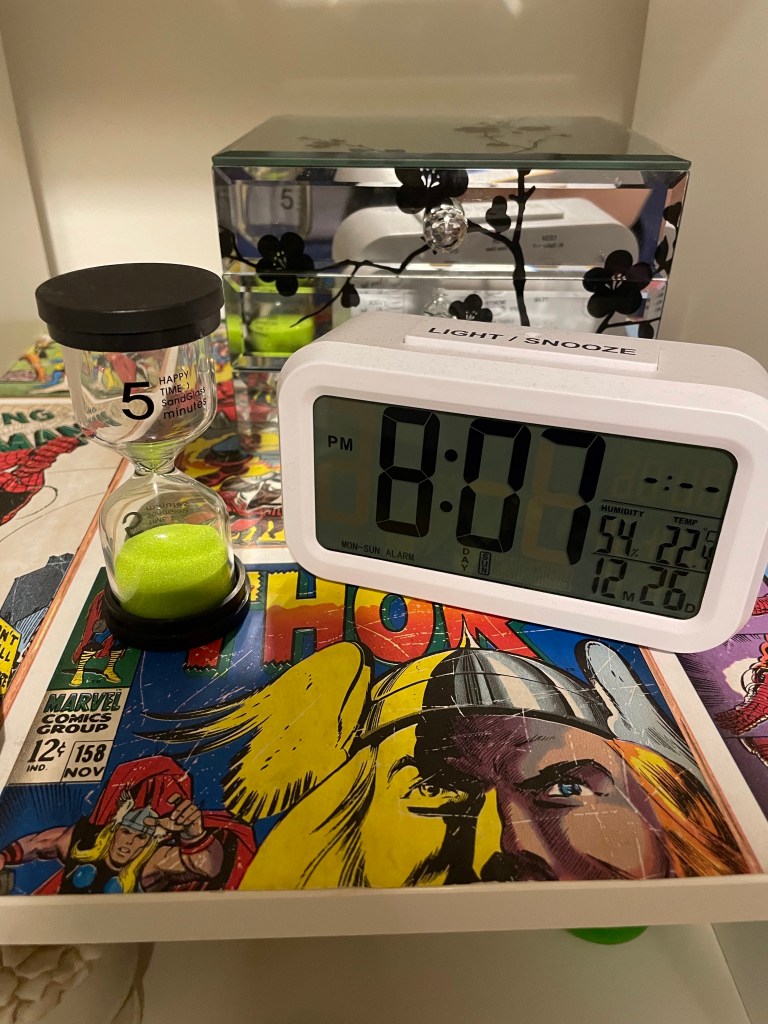
Clock and Timer – These are important things in our life. We bought a clock that tells him the time and day, but I also need him to realise what time it is. For example we start getting ready in the morning at 8am, this is so he can realise where we are in time. The timer is also a great tool, it keeps him focused. The other day I didn’t use any of the strategies (don’t ask me why!) and after about 10 times of asking him to get dressed I found him on the bed looking at something. When I asked him to get dressed again he said “O you wanted me to get dressed!” So out came the timer again!!

Morning Routine Chart

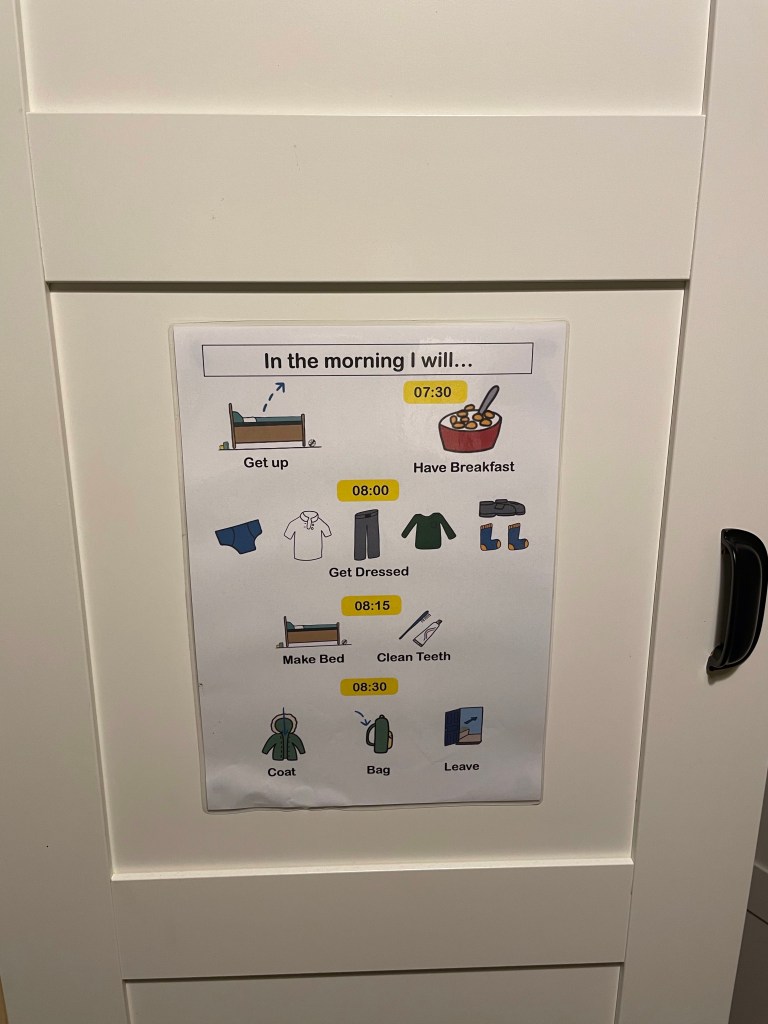
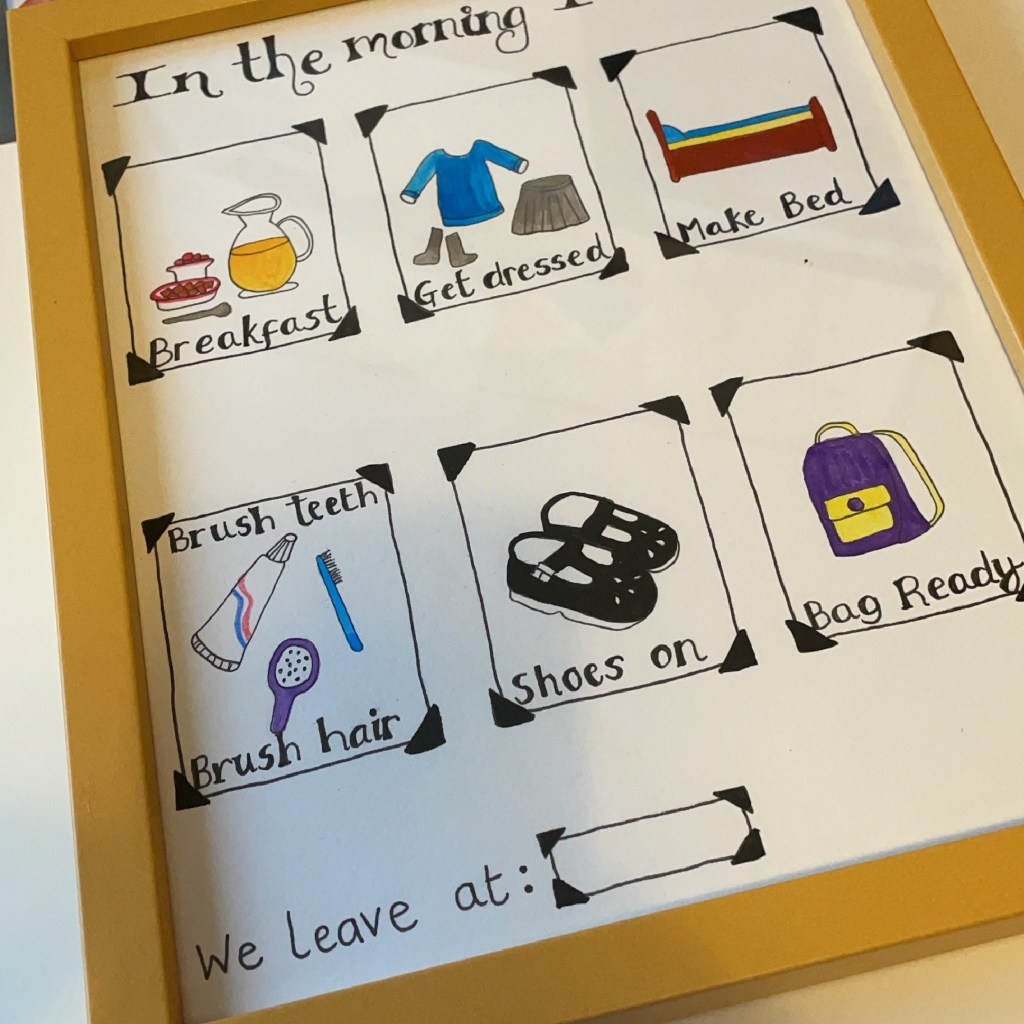
Morning Routine Chart – I’ve talked about this a lot, so won’t go into detail. But as you can see the labels in his wardrobe match the routine chart. So there is consistency.

I hope this helps you on your EF journey. I also hope it helps us on ours.

Let the picture timetable do the talking!

Using a picture timetable is another strategy you can have in your tool belt that may help those tricky times of day!

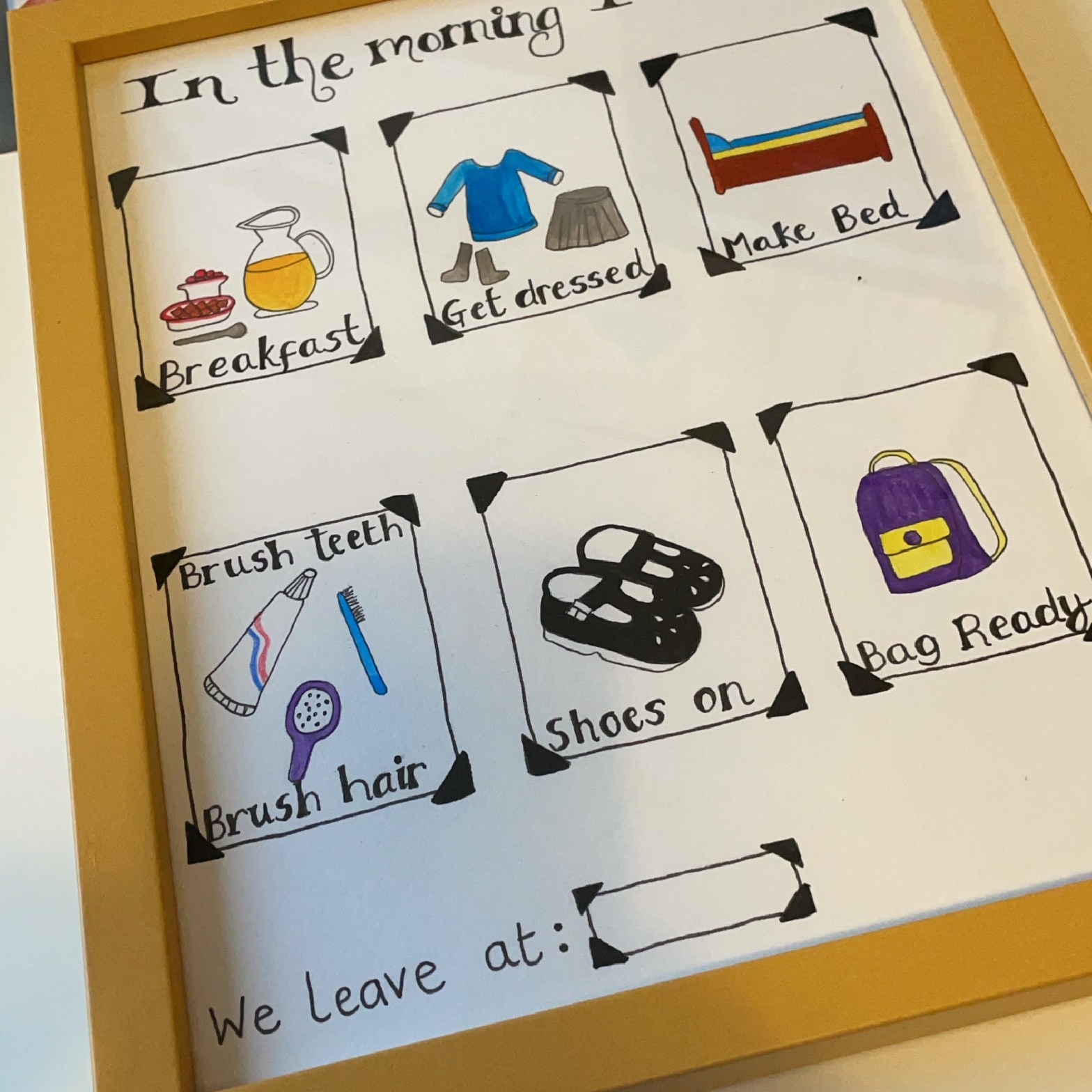
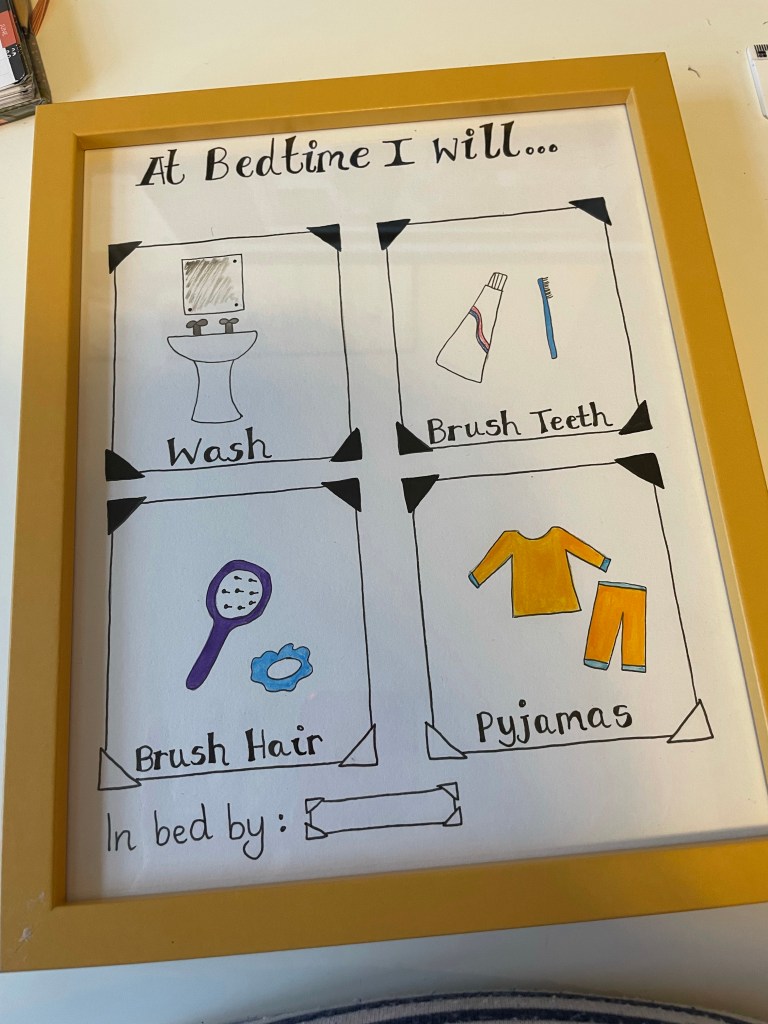
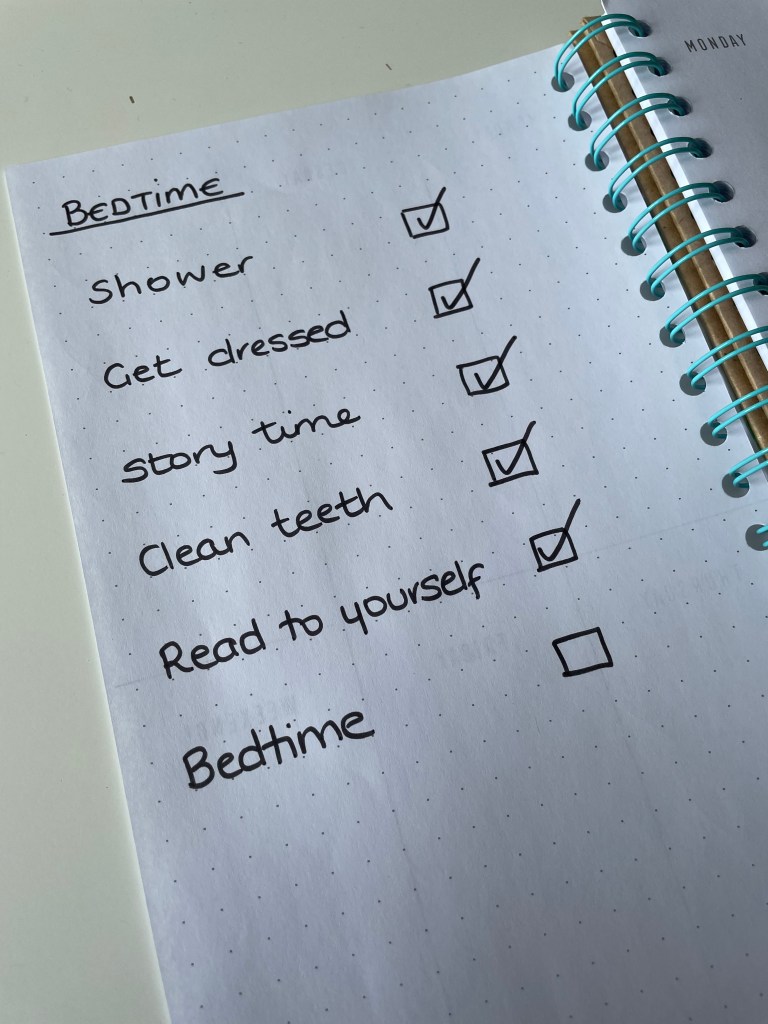
Very similar to a now and next board. But this time all the activities are all there in front of them and you tick them off as the activity is completed. They are really helpful for times like getting ready in the morning or getting ready for bed.

What is great about these frames is they become the authority; it’s not you nagging, its the frame telling them what to do.

So how do you use them? First break down the main activity into smaller tasks. E.g. Getting dressed is the main activity – break that down into small jobs, such as put on trousers, put on socks etc. You can either take photos or draw the items. Then put it in a picture frame. Make sure you put the frame in a prominent position, somewhere it will be seen and somewhere your child can reach it. When you are doing those tasks – go to the frame and see what the first job is. Do the job and then using a white board pen tick it off. Then look what the next job is and so on.

If you don’t feel confident in your drawing skills send me a message with the activities you want and I can make one for you for £10 or £15 for two.

My little one is a bit older, but I can now say – “go and look at the jobs on your frame” and mostly mornings are a million times better. But we have used the frame now for quite a few years.

The other great benefit of putting it in a frame is that you can wipe off the ticks and it’s ready for using again the next day. See if it works for you.

Transitions

Let me set the scene. You have been at a play group with your child for the last two hours and you have had a brilliant time. It’s time for the playgroup to finish and so you go over to your child and pick him up and say it’s time to go, then suddenly there is uproar. The tears start and the kicking starts and all you want to do is run! I haven’t yet met a single parent who hasn’t experienced this very scene.

All children find transitions difficult, whether it’s the big transitions such as starting nursery, changing classrooms or moving house or the small transitions such as leaving play group or having to stop playing because you’ve got to go and get your other child. Children with ASD, ADHD, Sensory Processing and other conditions find transitions particularly difficult too. Mainly because transitions require an element of flexibility, or they have to come away from an activity that they are hyper focusing on or for children with sensory processing, changing activity may result in a change of sensory input, which may be something they find difficult.

But for whatever the reason or whether your child doesn’t have a diagnosed condition there are ways that you can help all children cope better with transitions.

Prepare them – Imagine how you would feel if you were really enjoying something and then someone just came and picked you up and took you away from that really fun thing. You might kick up a fuss too. So prepare them that soon it is time to go. Even though they don’t understand time. You can still say things like we are going in 5 minutes, we are going in 3 minutes etc, but the act of saying that you are going a few times will help process the information and it may not be as difficult for them.

Prepare yourself – Get ready to go yourself before you start telling them it’s time to go. That way as soon as you have told them it’s time to go, you actually can go. They don’t have to wait around for you to get ready or more likely run back to the activity you’ve just managed to get them away from and you have to start the whole thing again.

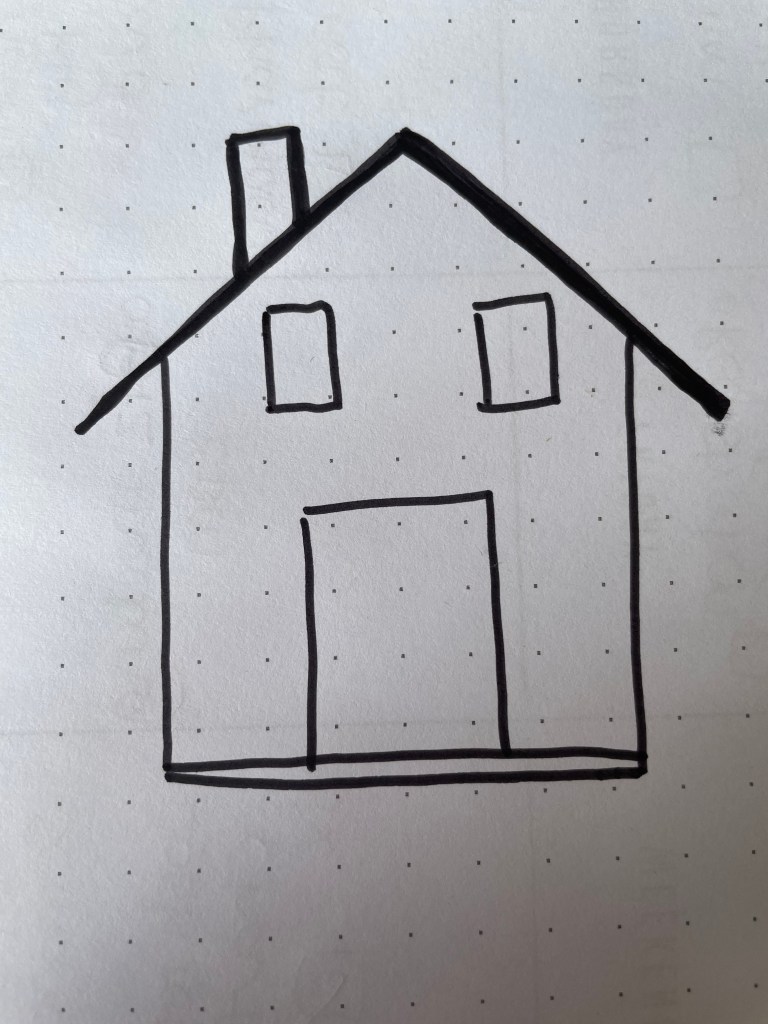
Simple Visual – At work with children who struggle to leave and go home, I have a very simple drawing of a house, that I can show them a few times, whilst saying it’s time to go home. The visual re-enforces the point that it is home time and also can draw their attention away from the activity. You don’t have to be a super artist, but it really supports what you are saying which is ‘we are going home’. Or for example you needed them to go to the toilet, you could draw a picture of a toilet etc.

Visual Timetable – Using a visual timetable again supports your communication of what is happening throughout the day. When we go on holiday and my little one gets confused because of the change in routine. I simply draw a picture for each key event of the day and then we can refer back to it when he needs to know what is happening.

Tick Sheet – This might be better with older ones. But who doesn’t like a to-do list. The key with this is your child is part of actively ticking off the event so they know that it is now finished. It can also show what is happening next.

Now and Next boards – A few weeks ago I wrote a blog post about the benefits of now and next boards. The board has a visual card for each activity and it shows what your child is doing now and what they are doing next so that they are pre-warned about what is going to happen.

Singing – When my little one was really little I would always sing ‘twinkle, twinkle, little star’ when it was time to put on his coat and whilst I was putting on his coat. He knew that when I started singing it, it was time to put his coat on. There are also lots of songs on youtube you could use about tidying up for example that you could sing when it is time to tidy up.

Timers – These days you have timers available on your phone or watch. So you can easily say, “when the timer goes ding ding, it’s time to let so and so have a go with the bike” or you can let them know that when the timer goes off its time for lunch or time to leave. Sand timers are also a really great resource so they can see how long is left.

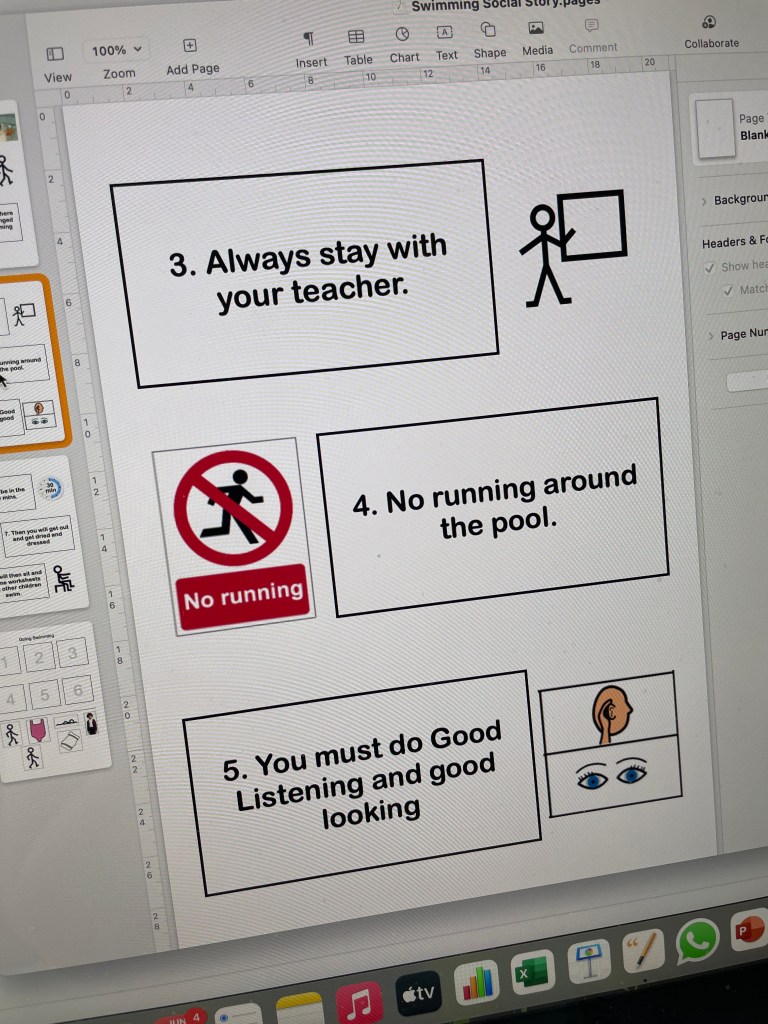
Social Stories – These are mainly for big transitions such as support with what to do at play time, or moving classes or moving house. But they are a great resource, if you are wanting to really show what will happen and what is expected of them.

Now I am not saying for one minute to use all of these strategies. You need to find the strategy that is right for you and your family. I sometimes use a different strategy depending on the situation. But you will find what works for you!

Hopefully with a few of these in your parent tool belt, you will feel a bit more confident in those times where in the past transitions may have been tricky!